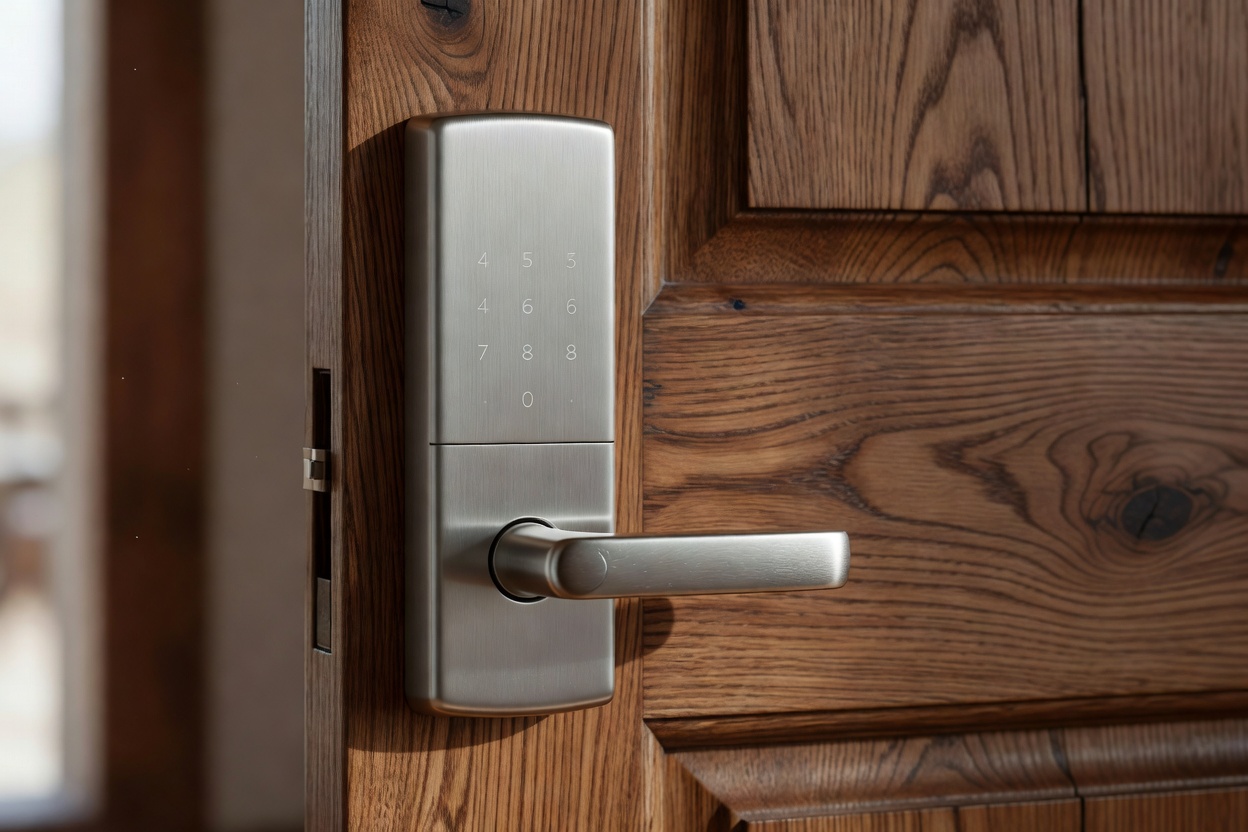
Key Takeaways
- UWB unlocking beats facial recognition on speed and reliability, but barely any locks support it and they cost a fortune
- Facial recognition actually solves a real problem: people who leave their phones inside the house
- The Eufy FamiLock E40 wins the category — fastest face unlock, Matter support, 2K doorbell with no subscription — but it's huge and drains batteries fast
- Infrared 3D mapping makes photo spoofing nearly impossible, so the security paranoia is mostly theater
I went into this test convinced facial recognition on a front door was a solution hunting for a problem. We already have keypads. We have fingerprint readers. We have geofencing that unlocks when your phone hits the driveway. Adding a camera that scans your face felt like the kind of feature marketing teams dream up to justify a $350 price tag.
Then my husband locked himself out. Again. He works in the garage, leaves his phone on the kitchen counter, and stands at the front door waiting for me to let him in. Geofencing doesn't work without the phone. Fingerprint readers need a free hand — try that when you're carrying lumber. That's when facial recognition stopped being a gimmick and started being a product.
The technology is genuinely clever. Every lock I tested uses infrared sensors to build a three-dimensional depth map of your face. Structured light, stereo IR cameras, time-of-flight sensing — different roads to the same destination. A flat photo holds no depth data, so the classic "hold up a picture of the owner" attack fails. I tried. It doesn't work. The security theater around facial recognition usually assumes 2D cameras; these aren't those.
Four locks on the market today do this. Eufy FamiLock E40 at $300. Lockly Visage Zeno at $350. Lockin Veno Solar Face at $199. Switchbot Lock Vision Pro at $230. There's a Kickstarter unit coming next month and a couple of Switchbot variants. I installed all four on the same door, one after another, and enrolled the same faces under the same lighting conditions.
The Eufy won. Not close. It unlocks the instant your face hits the sensor's field of view — under a second, consistently. The others hesitate. The Lockly takes two to three seconds. The Switchbot sometimes demands a second glance. The Lockin is fine until direct sunlight hits the sensor, then it falters. Speed matters on a front door. You don't want to stand there blinking at your own house.
Eufy also nails the ecosystem play. Matter-over-Wi-Fi means it talks to Apple Home, Google Home, SmartThings, Home Assistant without a proprietary hub. The 2K video doorbell is built in, no subscription cloud plan required — local storage or your own NAS. The keypad stays alive on a backup battery when the main pack dies. These are not trivial wins. Most smart locks force you into someone's cloud or brick entirely when power fails.
The tradeoffs are real. The Eufy is a slab. It protrudes three inches from the door face and dominates the visual field. Neighbors notice. The torch-sized battery pack drains in three months — half the life of the Lockly or Switchbot — because the IR illuminator runs every time someone approaches, not just on successful unlocks. Replacement cells cost $40. Plan on four a year.
Lockly's Visage Zeno looks like a normal deadbolt. Slim, understated, forgettable until you need it. Battery life hits six months. But the unlock lag grates, and the app feels like a 2018 IoT relic — clunky pairing, sporadic remote access, no Matter support yet despite promises. At $350 it's the most expensive and feels the least modern.
Switchbot's Lock Vision Pro sits in the middle. Decent speed, acceptable design, Matter support coming via firmware update they swear is imminent. The solar panel on the Lockin Veno Solar Face is a clever hack for battery anxiety, but the lock itself feels cheap — plasticky keypad, hollow turn feel, and that sunlight sensitivity is a dealbreaker for any door facing south.
Here's the inconvenient truth: ultrawideband radio blows all of them away. The Schlage Sense Pro I reviewed last month unlocks when your phone or watch passes the threshold, no camera, no face, no gesture. It's instant. It works with the device in a pocket, a bag, on a wrist. It doesn't care about lighting, hats, glasses, or beard growth. But UWB locks cost $400-plus and you can count the models on one hand. Schlage. Maybe one Yale. That's it.
So facial recognition isn't the best technology. It's the best available technology for people who don't want to carry a credential. That's a real market — spouses, kids, elderly parents, contractors, Airbnb guests who shouldn't have your Wi-Fi password. The Eufy FamiLock E40 serves that market competently. It's ugly, thirsty, and expensive. It also works.
If you have UWB money and UWB patience, wait. The radio future is coming. If you need hands-free unlocking today for someone who refuses to carry a phone, the Eufy is the only one that doesn't make you regret the compromise.