Key Takeaways
- A Spotify co-founder has now raised nearly $1 billion for a body-scanning service that has scanned 100,000 people and found a malignant mole on one tech founder's back
- The $700 million Series C — on the heels of a $260 million Series B just months ago — signals investors are betting big on preventive health as a consumer luxury product
- MidJourney, an AI image generation company, is building its own body scanner for a spa experience opening in 2027, suggesting the category is attracting operators with zero medical heritage
- Neko Health's integration with Apple Health data gives its clinicians real-world context, but the business model depends on wealthy users treating full-body scans like annual gym memberships
Daniel Ek just convinced two venture firms to write a $700 million check for a company that takes pictures of your insides. The Spotify co-founder and his partner Hjalmar Nilsonne have now raised $960 million in roughly five months. That number should make anyone pause. It suggests the market sees preventive scanning not as a medical service but as a consumer category — one that commands SaaS-like multiples on a hardware-and-clinician business.
The round was led by Lightspeed Venture Partners and O.G. Venture Partners. Atomico, General Catalyst, Lakestar, Liberty City Ventures, Positive Sum, and BDT & MSD followed. That syndicate size for a Series C is unusual. It reads less like conviction and more like FOMO distributed across a cap table. Everyone wants exposure to the "proactive health" narrative. Few want to lead it alone.
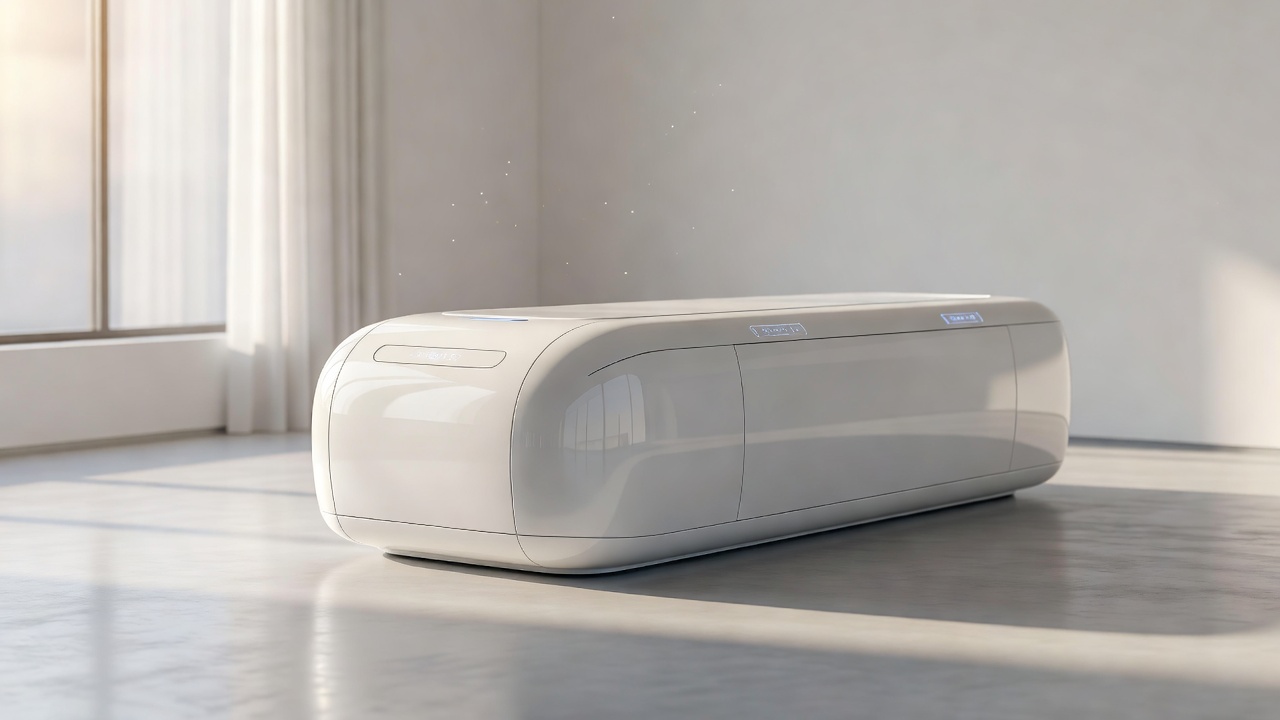
Neko Health's proposition is straightforward. You step into a scanner. It captures detailed body composition. You give blood. Clinicians combine both with your Apple Health data — sleep, heart rate variability, activity — to produce an assessment. The company claims more than 100,000 people have done it. Another 350,000 have joined a waitlist or booked appointments. If those numbers hold, Neko has already built a distribution engine most medtech startups would kill for.
The Alex Tew anecdote is the marketing team's dream. The Calm founder posted on X that a Neko scan found a malignant mole on his back. He had it removed. He credits the company with saving his life. One catch: a dermatologist with a flashlight could have found that mole. The scanner didn't detect cancer. It detected a visual anomaly on skin. That distinction matters. Neko's value proposition rests on the implication that its technology sees what doctors miss. The Tew story proves it sees what a mirror misses. Those are different claims.
Nilsonne argues Apple Health integration gives clinicians "real-world data." That is a genuine differentiator. Most preventive scans happen in a vacuum — a single snapshot of a body that changes daily. Continuous wearable data adds longitudinal context. If Neko's clinicians actually use that stream to adjust interpretations, the service becomes something closer to ongoing care than a one-off photo session. But the company has not published outcomes. No peer-reviewed studies. No false-positive rates. The $700 million buys trust before evidence.
The U.S. launch in New York will test the model. The UK and Sweden operate under different regulatory regimes. The FDA has not cleared Neko's scanner as a diagnostic device. It sits in a gray zone: wellness product with medical adjacency. That positioning works until it doesn't. One missed cancer, one overdiagnosis lawsuit, and the regulatory mood shifts. Investors at this price are betting the moat holds.
Then there is MidJourney. The AI image generation company — best known for letting users type "cyberpunk cat" and get a cyberpunk cat — is building a body scanner for a spa experience with hot tubs and saunas. San Francisco. 2027. This is not a medical company diversifying. This is an AI lab treating the human body as another dataset to visualize. The scanner becomes a content generator. The spa becomes the interface. MidJourney does not need clinical credibility. It needs Instagramable moments. That approach may actually reach more bodies than Neko's clinical veneer.
The convergence is revealing. Tech founders are funding body-scanning startups. AI companies are building body-scanning spas. The common thread: the body as data platform. Ek built Spotify on the insight that music consumption generates behavioral data. He is now applying that lens to physiology. Scan the body, track the changes, own the longitudinal record. The scanner is just the acquisition layer. The data moat is the business.
But bodies are not playlists. False positives carry biopsies. False negatives carry funerals. The unit economics of a scanner — real estate, technicians, clinician review, regulatory compliance — do not scale like software margins. Neko's $700 million implies a path to infrastructure scale: hundreds of locations, millions of scans annually, a dataset valuable enough to monetize beyond the scan fee. Pharma partnerships. Insurance integrations. Employer contracts. The pitch deck writes itself.
Whether the medicine holds is a separate question. Preventive screening in asymptomatic populations has a fraught history. PSA testing. Full-body MRI. Calcium scoring. Each promised early detection. Each generated cascades of downstream procedures with questionable mortality benefit. Neko's clinicians will face the same pressure: when the scan shows something ambiguous, do you refer? The safe answer is yes. The scalable answer is algorithmic triage. The profitable answer is whatever keeps the waitlist growing.
The valuation assumes Neko solves this. It assumes the data moat compounds. It assumes the wealthy users who populate the waitlist today become the recurring revenue base tomorrow. It assumes regulators classify the scanner as wellness, not diagnostics. It assumes MidJourney's spa model doesn't commoditize the experience first.
$700 million is a lot of assumptions. Ek has made bolder bets. Spotify looked irrational until it didn't. But music licensing is a known legal framework. Body scanning sits at the intersection of hardware, clinical judgment, data privacy, and medical regulation — each a minefield. The capital gives Neko time to navigate them. It does not give them the map.