Key Takeaways
- India commits nearly $20 billion to smartphones and chips, targeting China's 63% stranglehold on global phone production
- The policy pivot from assembly incentives to "depth, R&D and local value capture" admits India's current model is shallow
- Apple captures the immediate upside — 25% of iPhones now Indian-made — while its suppliers face new pressure to localize
- China's supplier ecosystem, not labor cost, is the real moat; subsidies cannot buy decades of cluster density overnight
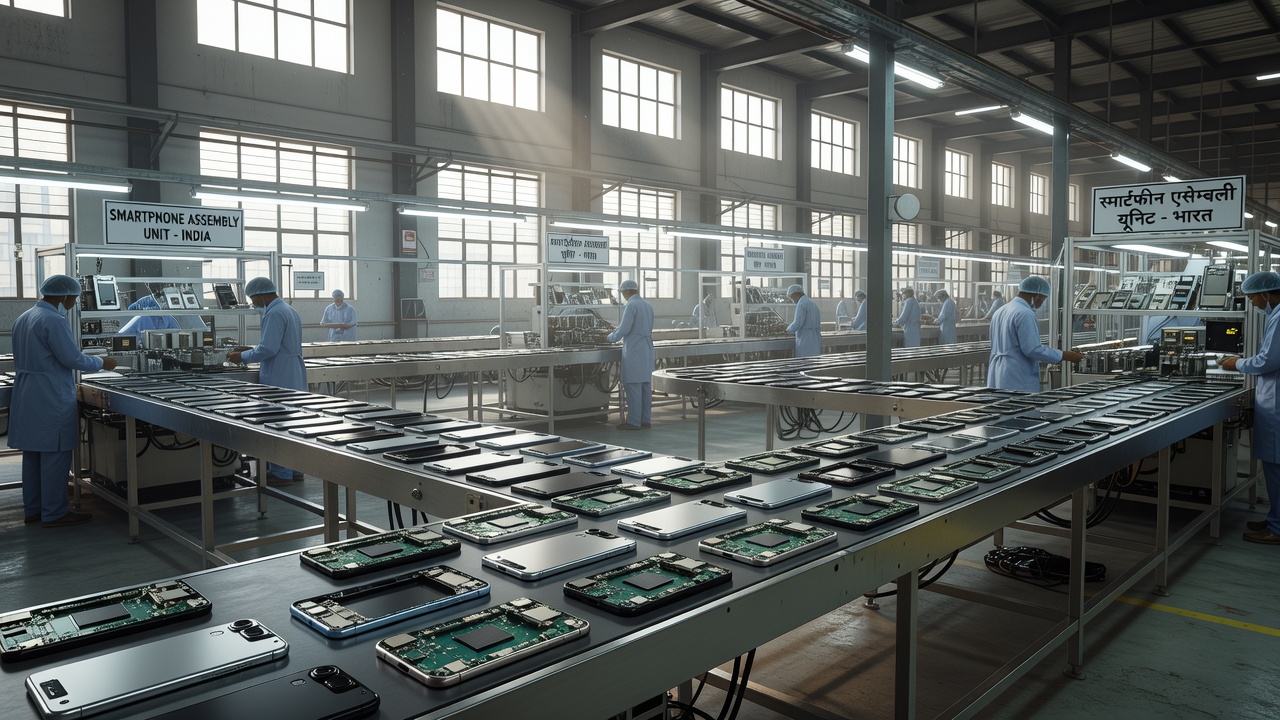
India just placed a $20 billion wager on a supply chain it does not yet own. The headlines trumpet record incentives — ₹625 billion for phones, ₹1.28 trillion for semiconductors — but the finer print reveals a government finally confronting its own illusion. For years New Delhi celebrated final assembly as victory. Foxconn lines screwing iPhones together in Tamil Nadu. Dixon-Vivo joint ventures cleared by bureaucrats who once blocked Chinese investment. Tariff cuts on components that still arrive in containers from Shenzhen. The new Mobile Phone Manufacturing Scheme quietly admits the truth: assembly is not manufacturing. The 2.25% to 5% sales incentives mean nothing unless the motherboards, display drivers, and RF front-ends inside those phones start carrying "Made in India" marks.
China accounted for 63% of global smartphone production in 2025. India managed 18%. That gap is not a labor arbitrage play. It is a cluster advantage built over three decades — tooling suppliers, mold makers, passive-component farms, substrate fabs, and a logistics lattice that moves a design change from CAD file to volume ramp in weeks. India has none of that at scale. The expanded semiconductor push acknowledges the void, but $13.3 billion in chip incentives mostly buys pilot lines and design houses. TSMC and Samsung did not build their ecosystems with subsidies. They built them with customer pull so violent it forced the supply base to coagulate around them.
Apple is that pull. Twenty-five percent of iPhones now exit Indian lines. Foxconn and Tata have learned to meet Cupertino's yield demands. The new scheme hands Apple a direct subsidy on every eligible device sold, while the extra 1.5% for local sourcing dangles a carrot in front of every Tier 1 and Tier 2 supplier: move capacity or lose the account. That pressure is real. It moves faster than policy. But it also creates a fragility — India's smartphone "success" is essentially the Apple supply chain wearing an Indian address. If Cupertino pauses diversification, the whole thesis stalls.
The Vivo-Dixon clearance signals political pragmatism beating security theater. New Delhi needs Chinese process knowledge more than it needs performative decoupling. Scrapping import duties on phone components is the same admission: the local parts bin is empty. You cannot tax your way into a supply base. You have to lure it, and the lure is volume. The government projects ₹39 trillion in production over five years — $405 billion. That number assumes Apple keeps expanding, Samsung deepens, Xiaomi stops treating India as a market not a factory, and a dozen new brands choose India over Vietnam. Each assumption is plausible. None is guaranteed.
Navkendar Singh at IDC calls the shift "depth, R&D and local value capture." That is consultant language for "we finally noticed we only do the easy bit." The scheme pays for eligible sales, not for transistor fabs or display driver IC design. The semiconductor expansion talks equipment, materials, design, research — but the first $10 billion chip program launched in 2021 has yet to produce a single logic wafer at volume. Incentives attract proposals. Volume attracts suppliers. India still confuses the two.
Sixty thousand direct jobs is the political metric. The real metric is how many component factories open without a subsidy clause in their business plan. Until that number moves, India is not breaking China's grip. It is renting a workaround.