Key Takeaways
- The Nopia finally ships after years of hype, priced at £550
- Its "harmony machine" architecture replaces traditional synthesis with chord-first performance
- Per-module MIDI output turns the instrument into a harmonic brain for your whole rig
- The designers built it for two-finger chord complexity, not knob-twisting
Martin Grieco and Rocío Gal have spent years dripping Nopia fragments across the internet. The wait ends in a couple of months. The price lands at £550. That number matters — it slots the unit between the boutique desktop boxes and the flagship workstations, daring buyers to treat harmony as a first-class instrument rather than an afterthought.
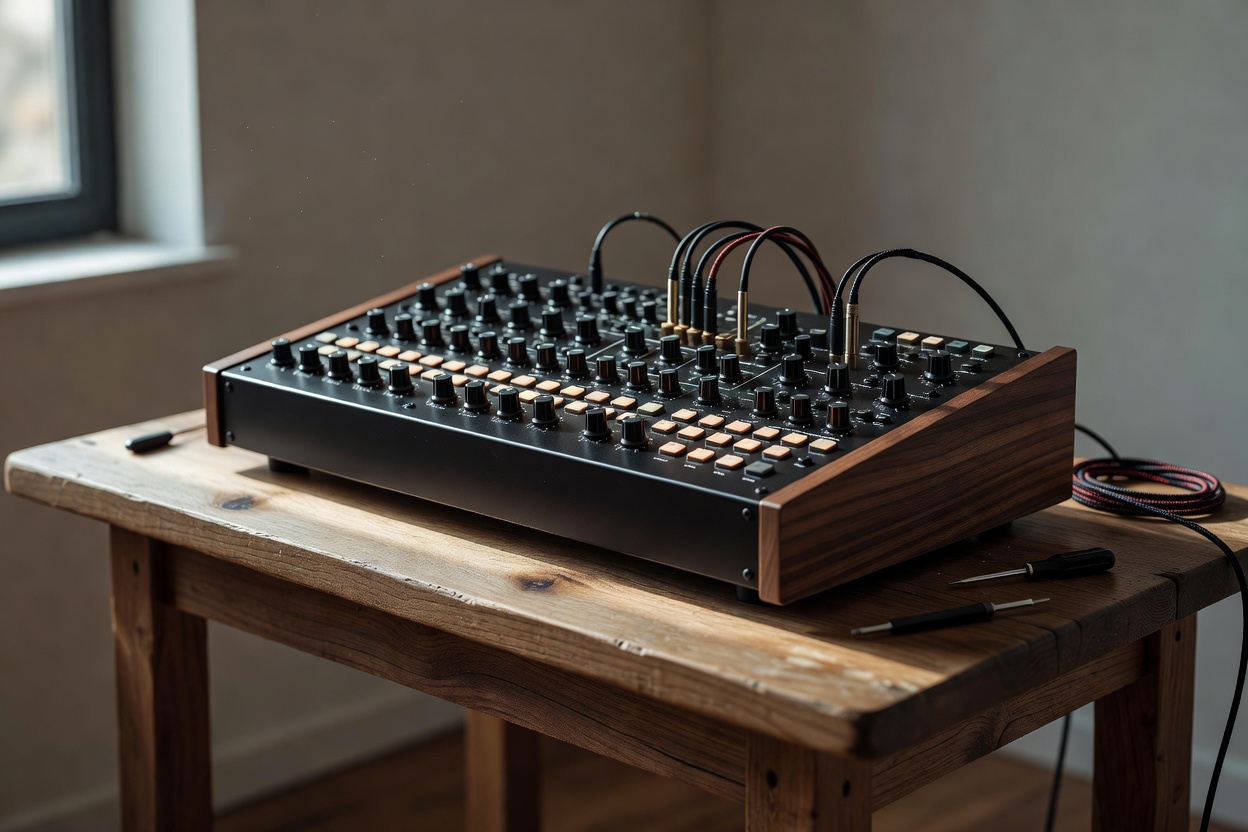
The marketing calls Nopia a harmony machine. The label earns its keep. Most synthesizers hand you oscillators and filters, then wish you luck building chords from scratch. Nopia inverts the premise. A one-octave Chord Builder keyboard, a twelve-button Tonal Selector, and an Extensions Dial lock key and voicing into muscle memory. You press two fingers. The machine voices the rest. That shift — from note entry to harmonic intent — rewrites the performance contract. A drumless groovebox is the comparison Grieco and Gal invite. It fits. The strum plate in the top-right corner plucks individual notes from a held chord. The pitch-bend slider bends the whole voicing at once. You play harmony the way a guitarist strums a chord shape, not the way a pianist voices one note at a time.
Under the hood, virtual analog and sample-based engines share the load. Basic effects — delay, reverb, tape emulation, beat repeat — sit ready. None of that surprises. The surprise lives in the MIDI implementation. Each module — keys, bass, arp, pad — spits out its own MIDI stream. Your external gear can follow Nopia's harmonic logic in real time. A modular rack, a second synth, a DAW track — all of them become extensions of the chord you just fingered. That single decision elevates Nopia from a clever box to a central nervous system for a hybrid rig.
Grieco and Gal know the demo videos made the internet hungry. They also know hunger curdles into skepticism when launch dates slip. "Basically finished" is the phrase they used at MusicRadar. The hedge is deliberate. Hardware veterans hear that phrase and clock the remaining firmware burns, the supply-chain roulette, the certification queue. A couple of months can stretch. But the unit in the room worked. The chord logic held. The MIDI streams stayed tight. The strum plate responded like an instrument, not a prototype.
The £550 ask assumes the buyer already thinks in harmony. If you still hunt for the perfect supersaw patch, Nopia will frustrate you. It refuses the patch paradigm. It demands you think in progression, voicing, tension, release. That demand narrows the market. It also guarantees the buyers who stay will use the thing differently. A synth that forces a new cognitive mode is rarer than a synth with a new filter type. The filter type gets copied in six months. The cognitive mode survives.
Competitors will copy the chord builder. They will not copy the per-module MIDI architecture until their firmware teams rewrite the whole stack. That window — eighteen months, maybe two years — belongs to Nopia. Grieco and Gal have a lead. They earned it by ignoring the knob count wars and solving the chord entry problem instead. The editorial verdict: the machine matters. Whether it ships on schedule is the only variable left.