Key Takeaways
- LEGO's $200 Donkey Kong cabinet launches August 1, targeting adult collectors with 1,367 pieces and probable mechanical interactivity
- The pricing signals a shift: LEGO Nintendo sets are no longer toys but premium display objects competing with high-end replica cabinets
- A simultaneous Pokémon wave and Cities: Skylines listing reveal LEGO's Nintendo partnership has graduated from occasional crossover to sustained franchise strategy
LEGO just priced nostalgia at two hundred dollars. The leaked Donkey Kong Arcade Cabinet — 1,367 pieces, 18-plus rating, August 1 street date — sits squarely in the premium collectible tier the company has been quietly building since the NES set proved adults will pay for mechanical cleverness disguised as brickwork.
That price is the story. Not the piece count. Not the minifigures. Two hundred dollars for a plastic cabinet that does not play Donkey Kong. You buy this to crank a lever and watch Jumpman hop over molded barrels, the same way you bought the NES set to scroll a tiny Mario across a tiny screen. The interactivity is the product. The bricks are just the delivery mechanism.
LEGO knows this. The 18-plus label is not a safety warning. It is a market declaration. This sits beside the $300 Atari 2600 and the $270 Pac-Man Arcade on the shelf — all three marketed as "adult" building experiences that happen to carry official licensing. The bricks have become irrelevant to the value proposition. You are paying for the licensed silhouette, the engineered motion, the permission to display Nintendo IP in your office without looking like a manchild.
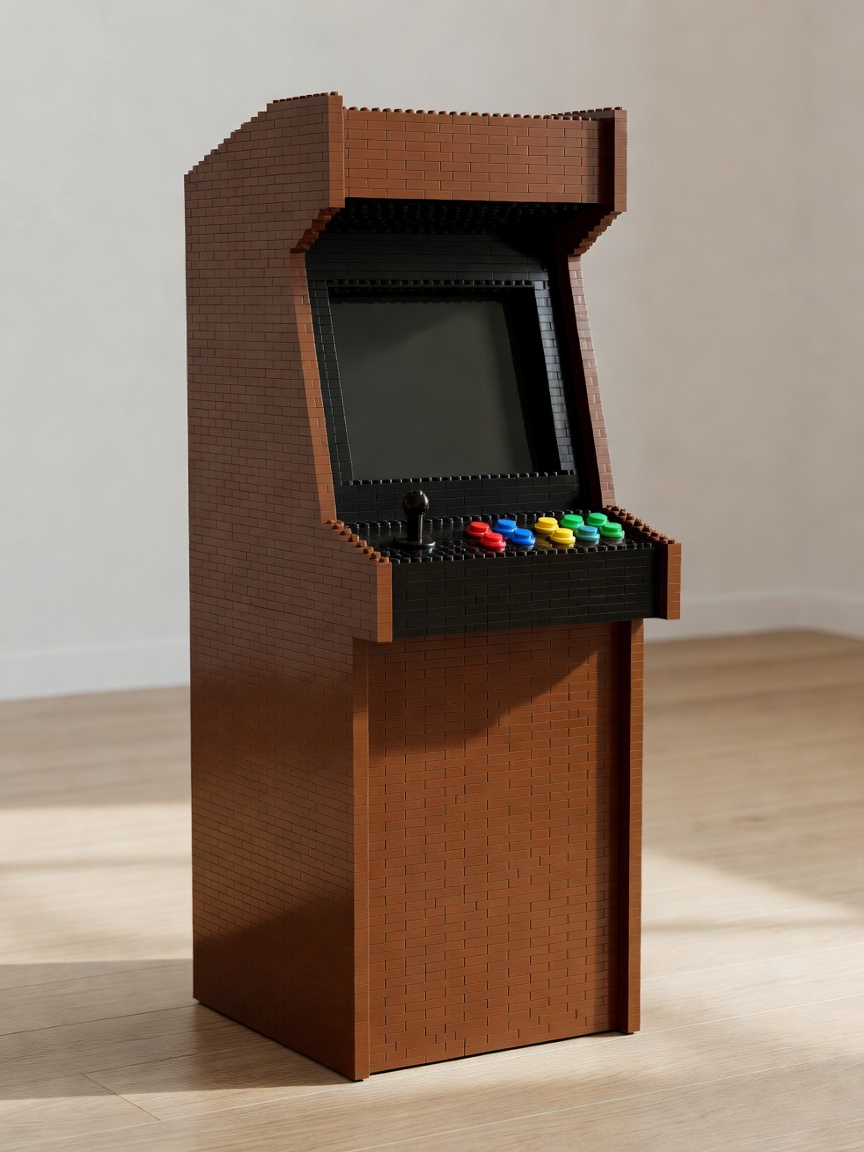
The leak photo shows the expected fidelity. Red DONKEY KONG lettering across the marquee. Donkey Kong, Jumpman, Princess Peach frozen in their eternal triangle. An arcade stick and button cluster at the base. If the NES precedent holds, the crank or dial mechanism will live inside the cabinet body, driving a scrolling level strip or moving obstacles along a track. Clever engineering. Limited replay value. But replay is not the metric. Display is.
Ask why August. The answer sits in the release calendar. October brings Pokémon wave two — Munchlax, Arcanine, Rayquaza, and the Poké Ball with Red and Professor Oak minifigures. That is a holiday quarter lineup. The Donkey Kong cabinet ships now to own the summer collector window, to seed social feeds before the Pokémon tsunami buries the algorithm. LEGO staggers these drops like a publisher managing AAA slate. They are not making sets. They are managing a franchise calendar.
Then there is Cities: Skylines. A ratings board filing surfaced last week. No images. No details. But the listing exists. LEGO SimCity — or LEGO Cities: Skylines — would represent the first time the brand tackles a pure management sim IP. No characters. No vehicles. Just zoning grids and traffic flow translated into modular districts. If real, it suggests LEGO's Nintendo-adjacent strategy has widened: they are now licensing the *aesthetic* of video games, not just their mascots.
That expansion should make Nintendo nervous. LEGO has become the primary physical manifestation partner for Nintendo IP — surpassing amiibo, surpassing Jakks Pacific, surpassing Nintendo's own merchandise arm. The Pokémon sets carry the Poké Ball display mechanic. The Mario sets carry the crank-scroll mechanic. The Donkey Kong set will carry whatever lever-gimmick its designers devised. Each release deepens LEGO's institutional knowledge of how to translate Nintendo gameplay loops into brick kinetics. That knowledge is portable. It does not belong to Nintendo.
The Donkey Kong cabinet will sell out. The price ensures scarcity optics. The August date ensures holiday re-stock conversations. The leak ensures pre-launch buzz without LEGO spending a marketing dollar. Reddit did the work. IGN amplified it. The cycle completes itself.
But here is the question the leak does not answer: what happens when the gimmick exhausts itself? The NES set scrolls one level. The Atari set holds cartridges you cannot play. The Pac-Man set lights up. The Donkey Kong set will crank barrels. These are single-trick ponies. The second trick requires a new set. The third trick requires another. LEGO has built a business model on selling the same mechanical revelation repeatedly with different skins. That works until collectors realize they own five boxes that do variations of "turn knob, watch movement."
Nintendo should watch that fatigue curve. Their IP dignity depends on the partner not cheapening the association. A $200 cabinet that cranks barrels is charming. A $250 Metroid cabinet that slides a morph ball is clever. A $300 F-Zero cabinet that tilts a track is stretching. The line between "premium collectible" and "expensive Happy Meal toy" is thinner than LEGO's margin on these kits.
For now, the Donkey Kong cabinet wins. It looks faithful. The price matches the tier. The August drop is disciplined. The leak was almost certainly intentional — LEGO's "leak" discipline is too consistent to be accidental. They want you talking about barrels and cranks in July. They want the pre-order queue forming before the Pokémon wave hits.
You will buy it or you will not. But understand what you are buying: not a game, not a toy, not even a model. You are buying a licensed mechanical demonstration that sits on a shelf and proves you were there when LEGO and Nintendo decided the future of physical gaming merchandise was a crank in a cardboard box wearing a $200 tuxedo.