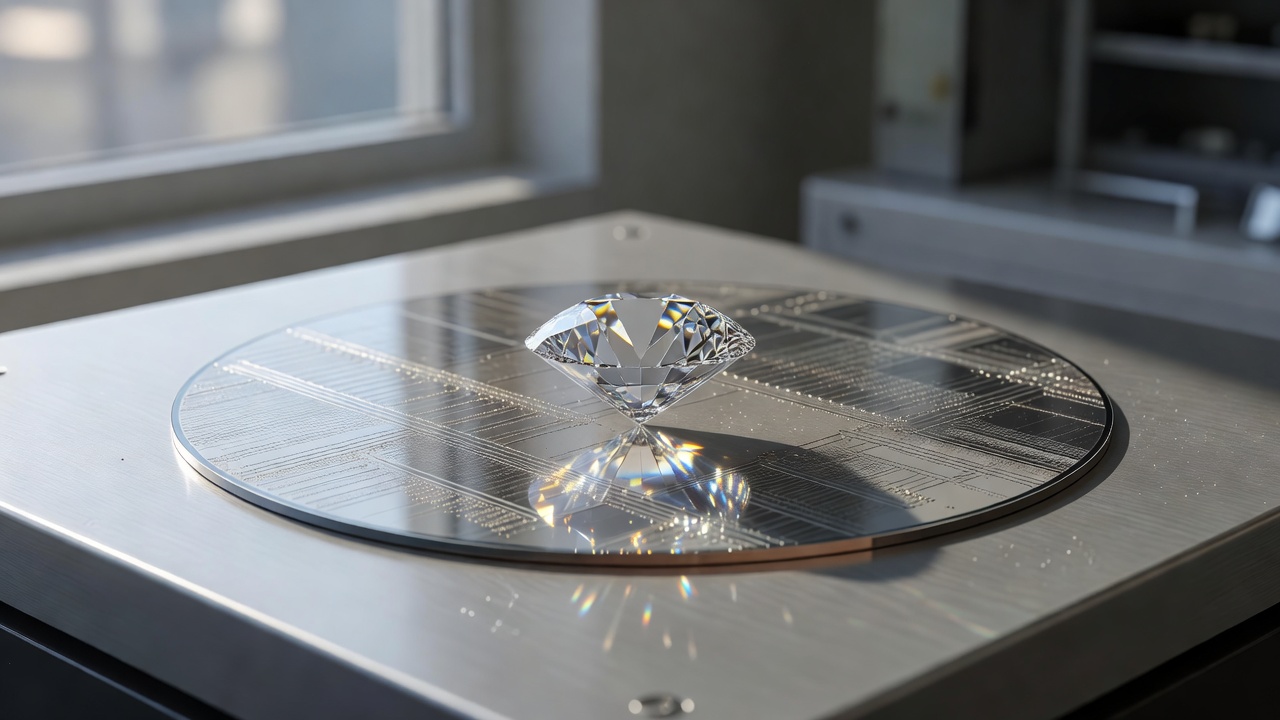
With EU backing, QuantumDiamonds aims to speed up chip manufacturing
Digital Frontier EditorialJuly 8, 20264 min read
Key Takeaways
QuantumDiamonds secures €76M in non-dilutive EU/German funding plus €15M equity to build Munich production facility
Startup's quantum diamond sensors compress weeks of defect detection into two minutes without stopping production lines
Technology pays for itself in months and sees "customer pull" across nearly the entire chip ecosystem
Europe's Chips Act mirrors US strategy — but execution, not subsidies, will determine if ASML gets company
Europe just bet €76 million on diamonds. Synthetic ones, embedded with quantum sensors, sitting inside a Munich factory that doesn't exist yet.
QuantumDiamonds, a Technical University of Munich spinout, landed the non-dilutive grant from Germany's federal economy ministry and Bavaria with European Commission approval. World Fund led a €15 million equity round alongside Bayern Kapital and a roster of existing backers. The startup declined to disclose valuation. CEO Kevin Berghoff says the raise moved fast because customers pulled them.
"Customer pull" is venture code for desperation. And the chip industry is desperate.
Foundries in Taiwan. Memory makers in Korea. Every fab on the planet runs the same bottleneck: inspection. Traditional metrology scans the top layer of a wafer through a microscope, destroys samples, takes weeks. QuantumDiamonds shoots magnetic fields through synthetic diamond defects — nitrogen-vacancy centers, if you care — and reads electrical flow through every layer in two minutes. Non-destructive. Inline. No line stoppage.
The math is violent. Berghoff claims customers recover hardware cost in months. Subscription fees for software interpretation sit on top. That software tells engineers exactly which process step to fix. The pitch writes itself.
Berghoff laughs when asked if buyers care about the quantum label. "They couldn't care less." Right. Buyers care about yield. The diamonds are synthetic. The quantum sensing is operational — not theoretical, not lab-bound, shipping now. That distinction matters. Most "quantum" startups sell physics experiments. This one sells throughput.
The subsidy trap
Europe's Chips Act mimics the US CHIPS Act. Subsidies. Strategic autonomy. Reduce reliance on Taiwan and the US. ASML holds the lithography monopoly; the Continent wants more. QuantumDiamonds fits the narrative: deep tech, university spinout, Munich address, quantum buzzwords.
But subsidies breed zoo animals. Protected from market pressure, they forget how to hunt.
Berghoff says the equity round was quick because of customer pull. Good. That signal matters more than the grant. The €76 million is non-dilutive — smart capital structure — but it's still public money de-risking private execution. The test comes when the Munich facility opens and the first production tools ship to fabs that have zero obligation to buy.
Foundries don't adopt because a government press release says they should. They adopt when the alternative costs more.
The real moat
QuantumDiamonds' moat isn't the diamond sensors. Patents expire. Competitors will replicate the physics. The moat is the data loop: every inspection feeds the interpretation software, which builds a process-knowledge graph no newcomer can replicate. That compounding advantage — if they execute — creates switching costs.
But execution is where European deep tech dies. Building production tools at scale requires supply chains, service networks, field engineers who speak Fab-ese. ASML didn't win with subsidies. It won by showing up at 3 AM when a scanner failed in Hsinchu.
QuantumDiamonds claims almost everyone in the chip ecosystem as a customer. "Almost everyone" usually means three pilot programs and two MOUs. Berghoff didn't name names. TechCrunch didn't either. I'll believe the roster when I see purchase orders.
Follow the money
$178 million total investment plan. €76M grant. €15M equity. The gap implies debt or customer prepayments. Prepayments would be the strongest signal of all — fabs putting cash down before hardware exists. If that's happening, the grant is decoration. If it's debt, the clock starts ticking.
World Fund led the equity. They know hardware. They know long cycles. Their conviction carries weight. But venture conviction follows traction, not grants.
What this actually means
Europe just funded a metrology company, not a chipmaker. That's honest. The Continent needs the whole stack — design, fab, equipment, materials — but equipment is the highest leverage per euro. ASML proves it. QuantumDiamonds targets the adjacent bottleneck: knowing what your fab did wrong yesterday, today.
The quantum label is marketing. The diamond label is physics. The two-minute inspection is the product. Everything else is noise.
Watch the Munich facility. Watch the first revenue recognition. Watch whether fabs renew subscriptions after year one. The grant bought time. The market buys survival.
Europe's chip ambition lives or dies on whether startups like this graduate from "strategic importance" to "supplier of choice." No ceremony. No politics. Just yield.