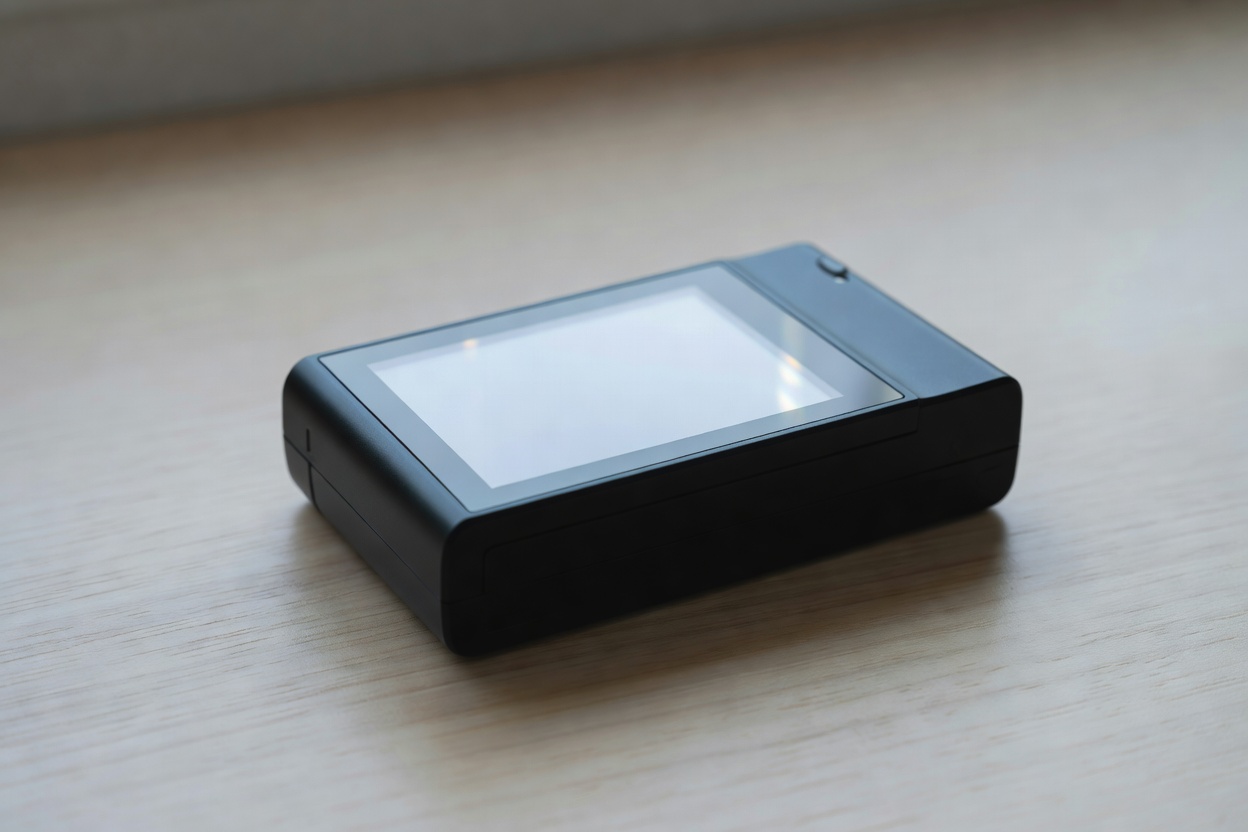
This slim camera has a transparent LCD screen for a viewfinder
Digital Frontier EditorialJuly 20265 min read
Key Takeaways
Godox's C100 ditches the rear LCD for a transparent viewfinder that shows settings, battery, and exposure data
The 65-gram camera shoots four aspect ratios to microSD, transfers via USB-C only — no wireless
It moonlights as a light meter, reading scene brightness and suggesting settings for other cameras
Priced around $29 in China with no confirmed international release, it undercuts even the toy-like Charmera
The viewfinder is the last honest component in photography. Everything else — the screen, the histogram, the AI scene detection — mediates. Godox knows this. Their new C100 doesn't just acknowledge the viewfinder's primacy; it reinvents it as a transparent LCD that floats exposure data over the world you're framing.
This is not a retro gag. The C100 weighs 65 grams. That's lighter than most lens caps. It shoots stills and video in four aspect ratios — 16:9, 1:1, and two others Godox hasn't bothered to specify — writing everything to microSD. No Wi-Fi. No Bluetooth. No app. You offload via USB-C or you don't offload at all. The spec sheet is a middle finger to connectivity theater.
The viewfinder does double duty
Transparent LCD technology has haunted trade shows for years. Samsung showed a transparent OLED laptop at CES 2024. Lenovo followed with a see-through ThinkBook concept. None shipped. Godox slapped one into a $29 camera and called it a light meter.
That's the genius. The viewfinder displays battery life, shooting mode, shutter speed, aperture — the usual cockpit clutter — but it also meters the scene. Point the C100 at a backlit portrait. It reads the brightness, calculates exposure, and hands you numbers you can dial into your actual camera. A point-and-shoot that teaches you to shoot. The parasite becomes the teacher.
What we don't know outweighs what we do
Godox's product page is a masterclass in strategic opacity. Sensor resolution? Unlisted. Video specs? Unlisted. Lens? Unlisted beyond "fixed focus." The company built its reputation on flashes and monolights — gear that demands precision. A camera with mystery innards feels like a category error, or a deliberate provocation.
Maybe the sensor is garbage. Maybe the lens is plastic. At ¥199 — roughly $29 — it barely matters. The Charmera, that viral toy camera with the film-advance lever that does nothing, sells for more. The C100 costs less than a decent ND filter. It's disposable by design, except the viewfinder suggests otherwise. That transparent panel implies engineering effort that doesn't belong in a loss leader.
The renaissance nobody asked for
Standalone cameras are back. Not because phones failed — they didn't. The iPhone 15 Pro shoots ProRes Log. The Pixel 8 Pro does computational magic that would have required a render farm a decade ago. But influencers hunt decade-old Canons on eBay. The Kodak Charmera, a plastic brick with a fake film crank, sells out repeatedly. Young photographers want friction. They want a device that does one thing poorly rather than everything perfectly.
Godox understands this market better than the legacy brands. Canon and Nikon protect their ILC lines. Sony protects its sensor business. Fujifilm leans into retro aesthetics but prices like luxury goods. Godox has no camera legacy to protect. They make lights. Lights are tools. The C100 is a tool that happens to capture images.
No wireless is a feature, not a bug
The absence of wireless connectivity will provoke complaints. Reviewers will call it a dealbreaker. They'll miss the point. Every wireless camera becomes a smartphone accessory — paired, managed, updated, notified. The C100 refuses the ecosystem. You shoot. You plug in. You copy files. The workflow ends. No cloud sync. No firmware nag screens. No account creation. The camera owes you nothing after purchase.
This matters more than megapixels. The modern camera experience is a subscription you never signed. Godox sold you a device that opts out.
Light meter as Trojan horse
The light meter function is the C100's secret weapon. Incident meters cost hundreds. Reflective meters built into cameras are fooled by backlight, snow, dark skin. The C100 reads through its taking lens — effectively a through-the-lens meter you can detach. Point it at the highlight. Read the suggestion. Apply to your A7R V or your X-T5 or your film Leica.
At $29, it's the cheapest calibrated meter on market. If the meter works. If the transparent LCD doesn't wash out in sun. If the battery lasts longer than a sitcom episode. Godox doesn't publish battery specs either.
China first, world maybe never
The C100 launched in China only. No international timeline. No FCC filing. No CE mark. Godox sells globally — their flashes sit in B&H and Adorama — but this camera might stay domestic. Chinese photographers get a $29 experiment. The rest of us get import markup and warranty roulette.
That's the pattern now. The most interesting cameras launch in Shenzhen first. The Yapii, the various toy CCD digitals, the Charmera itself — they incubate in a market that tolerates weirdness, then filter west through gray markets and TikTok. Western brands watch, wait, then release polished versions at ten times the price.
What this actually means
The C100 won't replace your daily driver. It might not survive a week in a backpack. But it proves something the industry forgot: a camera can be a single-purpose tool again. Strip the screen. Strip the radio. Strip the app. Keep the viewfinder — make it smarter. Sell it for the price of a meal.
Godox didn't ask permission. They built a camera that laughs at the category. The transparent LCD isn't a gimmick. It's a statement: the image happens in front of you, not on the back of the device. Everything else is distraction.
At $29, distraction is the only thing they couldn't afford to include.