Key Takeaways
- Thea Energy's $20M ARPA-E grant targets the stellarator's true bottleneck: magnet manufacturing, not plasma physics
- Twelve large magnets from four templates plus 300+ identical software-controlled small coils — a factory-first design that attacks cost at the root
- $120M private capital plus federal backing places Thea in fusion's top funding tier, but the mid-2040s commercial timeline remains a generational bet
The Department of Energy just handed Thea Energy $20 million to build magnets. That sentence alone tells you where the bottlenecks live in fusion power.
Magnets. Not plasma physics. Not tritium supply chains. Not regulatory frameworks. Magnets.
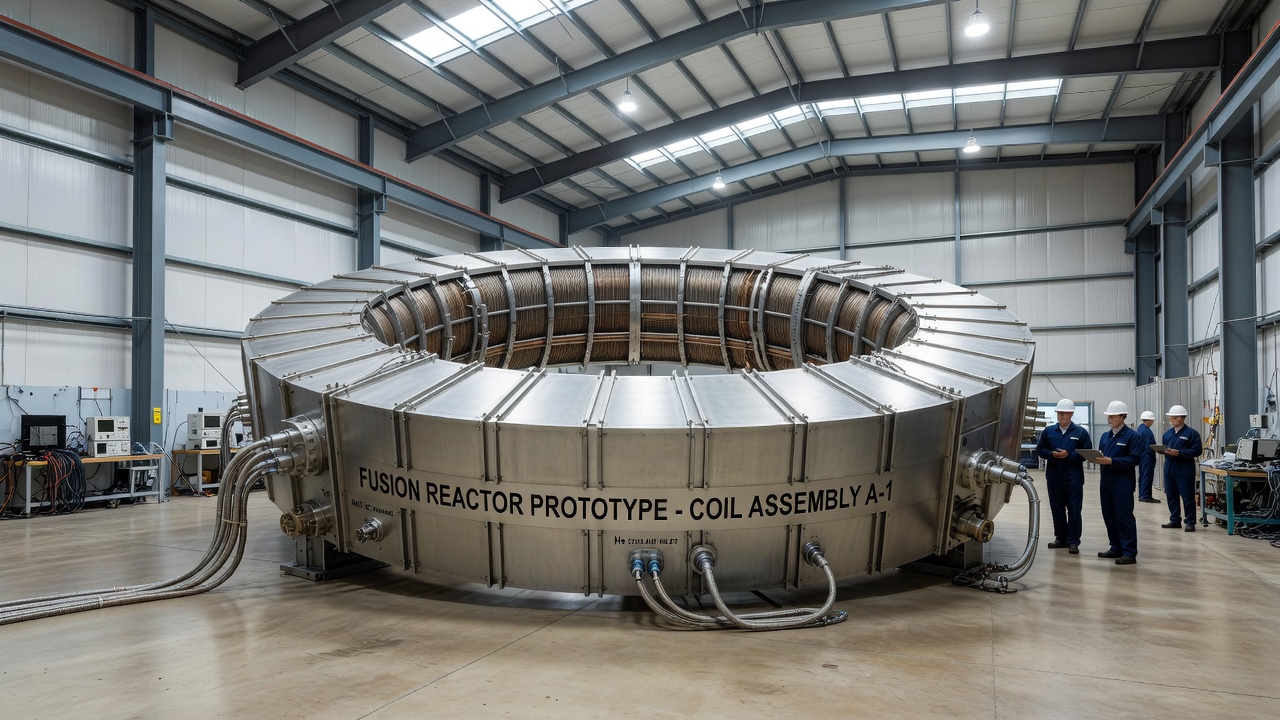
The award comes from ARPA-E, the agency Congress created to move energy technologies from lab curiosity to commercial reality. Thea will use the money to manufacture its high-temperature superconducting magnets — the components that make or break any magnetic confinement reactor. Stellarators, Thea's chosen architecture, have always been magnet nightmares. Their twisted plasma vessels demand magnets that twist with them. Every coil becomes a bespoke engineering project. Costs balloon. Schedules slip.
Thea bets on a different approach. Twelve large magnets carry the bulk of the field. Only four templates produce all twelve. Over three hundred smaller magnets fine-tune the plasma at the periphery, and every single one is identical. Software controls the array, not hardware precision. The logic is brutal in its simplicity: identical parts cost less. Software tolerates manufacturing variance that would scrap a hardware-tuned coil.
This is the real story. Not the $20 million — though that matters for a company that raised $100 million in May atop a $20 million Series A last year. The story is a fusion startup finally treating manufacturing as the central design constraint, not an afterthought.
Most fusion ventures still optimize for physics elegance. They chase higher beta, better confinement, cleaner instability boundaries. Thea optimizes for the factory floor. The stellarator's theoretical advantages — steady-state operation, no disruptive current-driven disruptions, inherent stability — have tempted physicists for decades. But the magnet complexity killed every commercial attempt before it started. Thea's modular bet acknowledges that the best physics that cannot be built is just academic decoration.
Software-defined magnet control carries its own risks. The startup claims forgiving construction tolerances. That promise lives in simulation today. Radiation, thermal cycling, neutron bombardment — the reactor environment will test whether software can truly compensate for hardware slop. If the control loops lag or the sensors drift, the plasma touches the wall. Game over.
The funding stack tells its own tale. $120 million private capital plus $20 million federal grant puts Thea in the fusion elite tier. Commonwealth, Helion, Zap — they sit in similar territory. But the timelines converge uncomfortably. Mid-2040s for commercial power. That is twenty years out. Two decades of engineering, licensing, supply chain maturation, and capital formation. The ARPA-E grant accelerates the magnet line. It does not collapse the timeline.
Skepticism is warranted. Fusion's history is a graveyard of "five years away" promises stretching back to the 1950s. Stellarators specifically have consumed billions in Germany's Wendelstein 7-X without delivering a reactor. Thea's modular magnets are a clever industrial hack. They are not a physics breakthrough. The plasma still must behave. The materials still must survive. The tritium still must breed.
Yet the DOE signal matters. ARPA-E does not fund science projects. It funds commercialization pathways. The grant says the agency sees a manufacturing thesis credible enough to back with taxpayer money. That thesis — identical parts, software control, factory-first design — may prove more durable than any single reactor concept.
Thea's next milestone is not a plasma shot. It is a magnet rolling off a production line that looks like a semiconductor fab more than a coil shop. Watch that line. The rest is commentary.