Key Takeaways
- A synth historian's new obsession with drum machines reveals rhythm, not timbre, as electronic music's true frontier
- Physical coffee-table books like Beat Gems survive because they curate what algorithms bury: context, lineage, and the weight of decisions made under constraint
- Freke's career — from Atari ST MIDI sequencing to Ableton Live — mirrors electronic music's journey from scarcity to abundance, and the creative loss that came with it
- The best gear writing treats instruments as arguments about how music should be made, not spec sheets
Oli Freke has spent thirty years explaining what synthesizers mean. Now he's turning to the machines that gave them a pulse. Beat Gems, his forthcoming coffee-table history of drum machines for publisher Bjooks, arrives at a moment when every plugin bundle includes a thousand kick drums and none of them carry the scent of a decision. That scent — the compromise between a engineer's budget, a manufacturer's deadline, and a musician's need — is what Freke has always chased. His 1995 cutoff for the synthesizer book wasn't arbitrary. It marked the moment digital convenience began to erase the friction that made early instruments sound like something instead of everything.
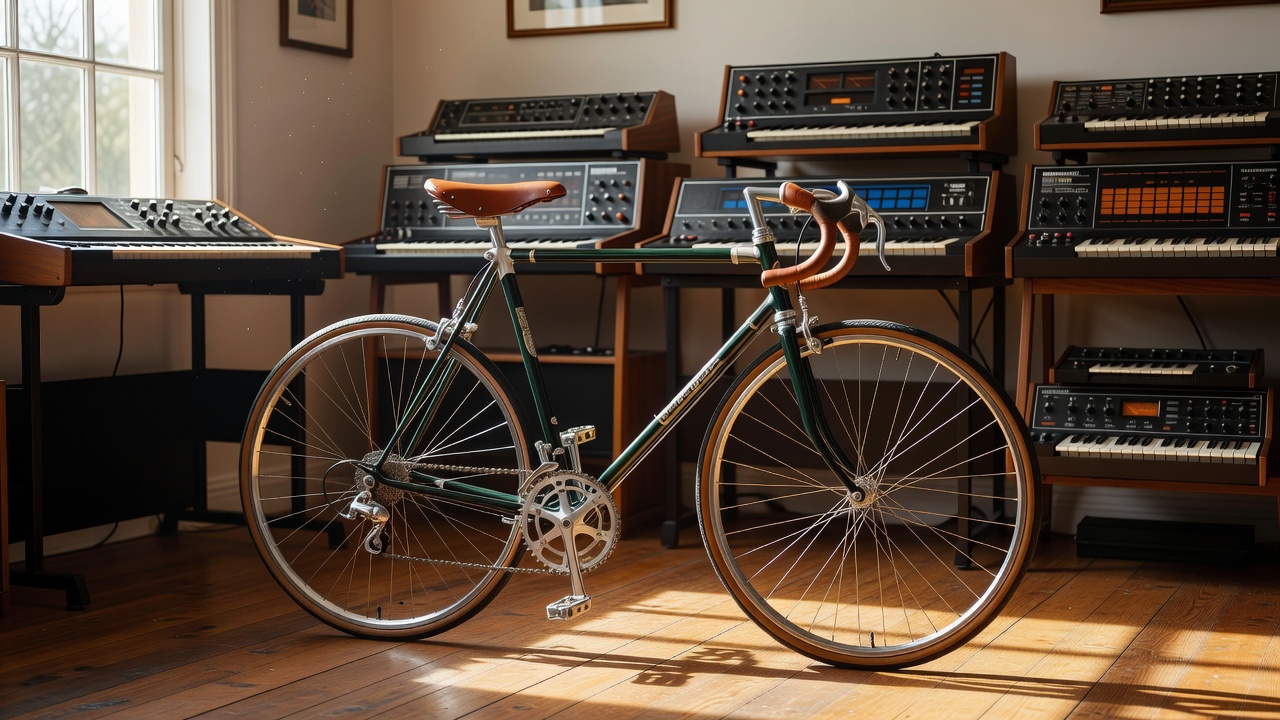
The title of this piece mentions a bicycle. Freke didn't say that. But he did say his father told him to say yes to opportunities and figure out the execution later. That's how you end up with a bicycle you can't afford and a book contract that demands you photograph a Roland TR-808 in lighting that does justice to its plastic ridges. It's also how electronic music moved from the Atari ST — where Freke sequenced MIDI with no audio at all — to Ableton Live, which he installs first on any new machine. The distance between those two environments isn't technical. It's philosophical. The ST forced you to hear the music in your head before you heard it in the speakers. Live shows you the waveform as you draw it. The latter is faster. The former made you a composer.
Freke understands this. His writing for Sound on Sound, The Quietus, and Mixmag has never been about specs. It's been about the melodic potential of the Western 12-tone scale, the mathematical architecture of a filter's resonance, the way a plug-in's distortion curve changes the chords you're willing to write. Beat Gems extends that logic to rhythm. A drum machine isn't a metronome with samples. It's a compositional constraint. The TR-808's accent pattern, the Pērkons' probability sequencing, the LinnDrum's trigger delay — each one suggests a different relationship between human intention and machine execution. Freke's photographs and captions treat those differences as ideas worth preserving.
Bjooks publishes objects, not PDFs. That matters. A coffee-table book demands curation. You cannot infinite-scroll a 300-page spread of Erica Synths' modular oddities beside a 1970s Ace Tone Rhythm Ace. The physical page forces adjacency. It makes you see the lineage from preset rhythm boxes to programmable pattern generators as a single argument about control. Algorithms optimize for engagement. Books optimize for understanding. Freke's choice of publisher is itself a statement: the history of electronic rhythm deserves the weight of paper, the permanence of ink, the resistance to revision.
His current obsession — drum machines — lands at the center of a debate the industry prefers to ignore. Melody gets the glory. Harmony gets the theory. Rhythm gets the grid. But Freke's research reminds him, and now us, that rhythm is the primal musical experience. The first instrument was a struck object. The first synthesizer was a voltage-controlled oscillator. The first drum machine was a compromise between a Wurlitzer organ's accompaniment section and a session musician's union rules. Every subsequent innovation — the CR-78's microtonal tuning, the TR-808's flamenco patterns, the Pērkons' Euclidean sequencer — rearranges the relationship between the player and the pulse. That rearrangement is where style lives.
Freke wishes he'd written a song the whole world knew. He has instead written the books that explain the tools that made those songs possible. The trade is fairer than it looks. A hit song becomes a burden. A history book becomes a reference. When a producer in 2035 wonders why the TR-808's cowbell sounds like a midnight decision, Freke's caption will still be there. The bicycle, if he buys it, will rust. The book won't.
The vegetable chopper anecdote lands perfectly. Gadgets that promise to eliminate labor without understanding the labor usually fail. Drum machines that promise to eliminate the drummer without understanding the drummer suffer the same fate. The best ones — the 808, the 909, the MachineDrum, the Pērkons — don't replace the human. They propose a new collaboration. Freke's work, across decades and formats, has always been about that proposal. He maps the terrain where human intention meets machine logic. Beat Gems is his most detailed map yet.
Say yes to the opportunity. Worry about the execution later. That's how you get a bicycle, a book, and a career that traces the nervous system of electronic music from analog voltage to digital abundance and back again. The cycle matters. The return to constraint matters. Freke's drum machine history arrives exactly when the field needs to remember that infinite choice is its own kind of silence.