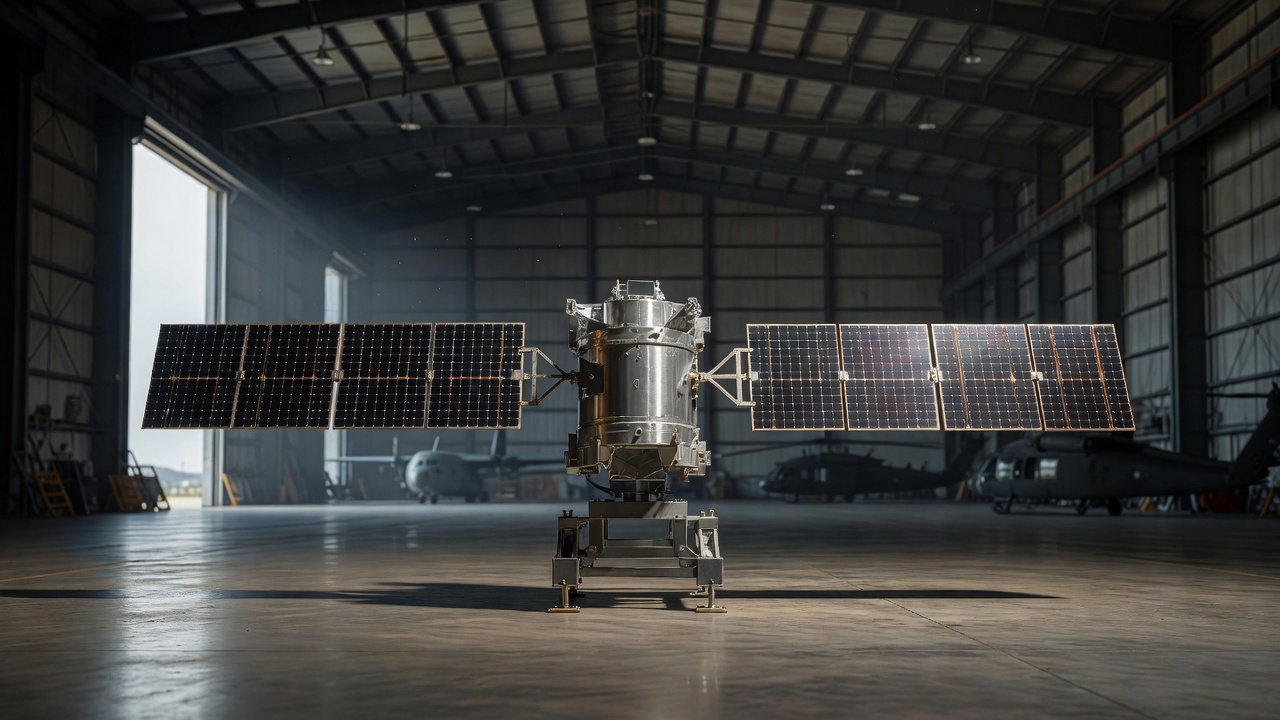
NASA launched an emergency mission to stop the Swift Observatory from crashing to Earth
Digital Frontier EditorialJuly 20265 min read
Key Takeaways
A $30 million rescue mission assembled in nine months is racing to save a $500 million observatory from burning up this year
Solar storms dragged Swift 150 miles below its operational orbit — the satellite has no propulsion to save itself
Katalyst Space Technologies' three-armed Link spacecraft must grapple a tumbling, uncooperative target traveling 17,500 mph
If successful, this becomes the first commercial on-orbit servicing of a NASA science satellite — a proof point for an entire industry
The math is brutal. A $500 million observatory circling at 224 miles, bleeding altitude with every orbit. No engines. No way to push back. By October, atmospheric drag would swallow it whole.
NASA didn't wait for a better plan. They wrote a $30 million check and gave Katalyst Space Technologies nine months to build a spacecraft that could catch a falling satellite and shove it back to safety.
Link launched Friday. Three articulated arms. One shot at redemption.
This isn't how space operations usually work. Government missions crawl through decade-long procurement cycles. Requirements documents balloon. Review boards multiply. Katalyst broke that mold because the physics left no choice — solar maximum arrived early and angry, swelling Earth's upper atmosphere into a drag pocket that has been eating Swift's orbit for months.
The Neil Gehrels Swift Observatory carries a scientific debt that most people don't know they owe. Gamma-ray bursts — the universe's most violent explosions — flash across the cosmos carrying secrets about the first stars, the birth of black holes, the fabric of spacetime itself. Swift catches them. Pinpoints them. Directs the world's telescopes to their afterglows. Since 2004, it has triggered follow-up observations that rewrote textbooks on stellar death and cosmic dawn.
Losing it would punch a hole in time-domain astronomy that no other instrument can fill.
The interception problem
Link's job description reads like a nightmare scenario. Rendezvous with a 3,000-pound satellite that cannot communicate its orientation, cannot fire thrusters to stabilize, cannot do anything but tumble through a decaying orbit at 17,500 miles per hour. Then extend three robotic arms, clamp onto a spacecraft never designed for grasping, and fire engines to lift the combined mass 150 miles higher.
No one has done this with a NASA science satellite. The few on-orbit servicing demonstrations — Northrop Grumman's Mission Extension Vehicles, DARPA's RSGS — targeted cooperative geostationary birds built with docking interfaces. Swift has a launch ring and prayer.
Katalyst's CEO, Chris Jenkins, calls it "the hardest thing we've ever attempted." His company employs 40 people. They built Link in a former warehouse in Cape Canaveral. The spacecraft looks like a mechanical spider — central bus, threefold symmetry, each arm jointed with force-torque sensors feeding a guidance system that must adapt in real time to Swift's unknown tumble state.
Speed as a strategy
Nine months. That number keeps resurfacing in conversations with the team. NASA's Space Communication and Navigation program office, which funded the rescue, treated it like a wartime production order. Requirements froze at kickoff. Environmental testing compressed. Software shipped with known bugs slated for on-orbit patches.
"We traded process for probability," one engineer told me. "Every review we skipped was a risk we accepted. The alternative was zero probability — Swift burns up."
The industry watches closely. On-orbit servicing has been "five years away" for two decades. Investors have funded PowerPoint decks and ground demos. Katalyst just proved a small team can design, build, test, and launch a operational servicer in the time it takes a traditional prime contractor to complete a preliminary design review.
That matters. The commercial servicing market hinges on credibility. Satellite operators need to believe a rescue craft will actually show up. Insurers need to underwrite the risk. Regulators need to license the proximity operations. A successful Link mission rewrites the business case for every company betting on this future.
The solar wildcard
Swift's predicament exposes a structural vulnerability nobody planned for. The observatory launched during solar minimum. Its 373-mile circular orbit felt permanent. Twenty years later, Solar Cycle 25 peaked harder and earlier than models predicted. The thermosphere expanded. Drag increased. Swift's altitude dropped 150 miles in eighteen months.
No one owns the problem. NASA's heliophysics division operates Swift. The Space Communication and Navigation office paid for the rescue. The Science Mission Directorate will decide whether the extended mission justifies continued operations funding. Meanwhile, the satellite drifts.
This fragmentation will repeat. Dozens of LEO science satellites lack propulsion. The next solar maximum arrives in eleven years. The one after that in twenty-two. Each cycle will claim more spacecraft unless servicing becomes routine.
What happens next
Link's chase phase begins now. Ground controllers will spend weeks characterizing Swift's tumble — rate, axis, nutation — using optical navigation and radar cross-section analysis. The grapple attempt won't happen until the team models every contact scenario.
Failure modes multiply. An off-center grab could impart spin that overpowers Link's control authority. A structural mismatch could shear an arm. Fuel margins leave zero room for retry.
But the alternative was decided in October. Swift becomes a fireball. Gamma-ray astronomy loses its sentinel. The servicing industry loses its clearest proof point.
Nine months. Three arms. One shot. The spacecraft is flying. The clock is ticking. Physics doesn't negotiate.