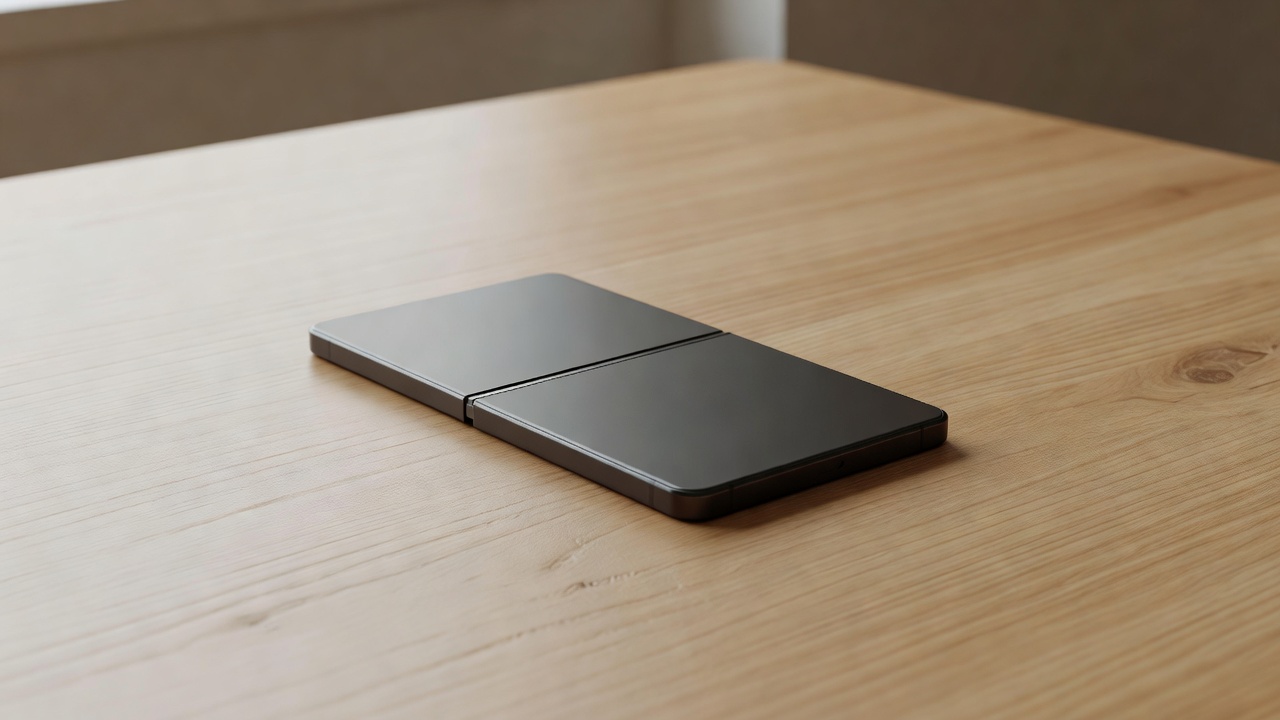
Key Takeaways
- Foldables have survived their disaster era and become merely competent
- The category's maturity removes the risk that kept Apple away
- Samsung and Chinese rivals have done the expensive R&D for Apple
- Apple can now enter with a refined product while competitors fight on specs
The first foldable phone was a punchline. Royole's FlexPai earned the phrase "charmingly awful" before the company went bankrupt. Samsung's Galaxy Fold followed with review units that broke in days — a failure so public it scared Huawei into delaying its own launch by five months. Motorola's first Razr and Samsung's first Z Flip scored four and six out of ten. The category spent two years as a warning label.
That history matters because Apple watched all of it from the sidelines.
Seven years later, the flagship book-style price hasn't moved from $2,000. But the floor has dropped. Motorola sells a Razr for $799. Samsung's Z Flip 7 FE lists at $899. The creases have flattened. The hinges hold. The cameras no longer embarrass themselves against slab flagships. Stylus support appears on some models. The form factor itself is mutating: Huawei's Mate XT trifold, the widening Pura X line, Samsung's Z TriFold and the squat Z Fold 8. The category has stopped asking "does it work?" and started asking "which shape wins?"
That transition — from existential risk to form-factor debate — is the single best thing that could have happened to Apple's eventual entry.
Apple does not invent categories. It waits for them to prove themselves, then applies polish at scale. The iPod arrived years after MP3 players. The iPhone arrived years after smartphones. The Watch arrived years after fitness bands. In each case, the early movers burned money solving the hard problems: battery chemistry, supply chains, developer expectations, consumer skepticism. Apple entered when the category had become boring — when competence was assumed and differentiation moved to software, ecosystem, and finish.
Foldables have reached that moment.
Samsung has spent seven generations teaching supply chains how to laminate ultra-thin glass without delamination. It learned that display layers cannot peel like screen protectors — a lesson paid for in warranty claims and ridicule. Google, OnePlus, Oppo, Vivo, Xiaomi, and Honor have collectively stress-tested hinge mechanisms across millions of cycles. They have normalized the idea that a phone can fold, survive a drop, and take a decent photo. They have built the repair infrastructure, the accessory ecosystem, the app optimizations. They have absorbed the early-adopter tax so Apple doesn't have to.
The boringness is the signal. When a category becomes iterative — wider cover screens, trifold experiments, FE variants at lower price points — the technology risk has evaporated. What remains is product risk: industrial design, software integration, services attachment. That is Apple's home turf.
Consider the competitive landscape. Samsung dominates Western foldable share but iterates cautiously. Its Z Fold 8 adopts the wider "squat" proportion pioneered by Huawei's Pura X Max — a follower move disguised as leadership. Chinese manufacturers push hardware faster but lack the services moat that makes iPhone users sticky. Google's Pixel Fold line shows software ambition but minimal hardware control. No competitor owns the stack the way Apple does.
An Apple foldable — call it iPhone Fold, call it something else — would not need to justify the form factor. The market has done that. It would not need to prove durability. Samsung's FE tier proves the bill of materials works at $899. It would not need to teach developers. Android's foldable APIs and Google's own apps have forced the ecosystem to adapt. Apple would inherit a ready-made software target.
What Apple would bring is the thing no Android vendor can deliver: a seamless handoff between folded and unfolded states across iPhone, iPad, Mac, and Vision Pro. Continuity, Handoff, Universal Control — these are not features you bolt on. They require vertical integration. The foldable that matters is not the one with the flattest crease or the widest cover screen. It is the one that becomes a natural extension of the user's existing device constellation.
The timing aligns. Vision Pro needs a pocketable companion that unfolds into a spatial computing canvas. The iPad mini needs a sibling that fits in a jeans pocket. The services revenue machine needs a new hardware anchor. A foldable iPhone answers all three — but only because the category has become boring enough to support it.
Samsung will ship a Z Fold 9 and a Z Flip 9. They will be thinner, lighter, slightly cheaper. Huawei will push a quad-fold. Xiaomi will chase a spec sheet. The press will compare crease visibility and hinge torque. Apple will ignore the spec war and ship a product that feels inevitable — because the industry spent seven years making it so.
Boring is the sound of a category ready for Apple. The wait is nearly over.