Key Takeaways
- Apple's dead car project birthed the Neural Engine that now powers every iPhone, Mac, and future server chip
- The company is skipping M6 Pro/Max/Ultra entirely to rush M7 with massive Neural Engine upgrades by mid-2027
- M7 Ultra will support 1.5TB RAM — a server play that signals Apple's real AI ambition isn't consumer devices
- Apple's hardware lead masks a software deficit; the privacy narrative depends on silicon the car team built
Apple never shipped a self-driving car. The project burned billions and years before collapsing under its own weight. Yet the wreckage contains the most valuable asset Apple owns: the Neural Engine.
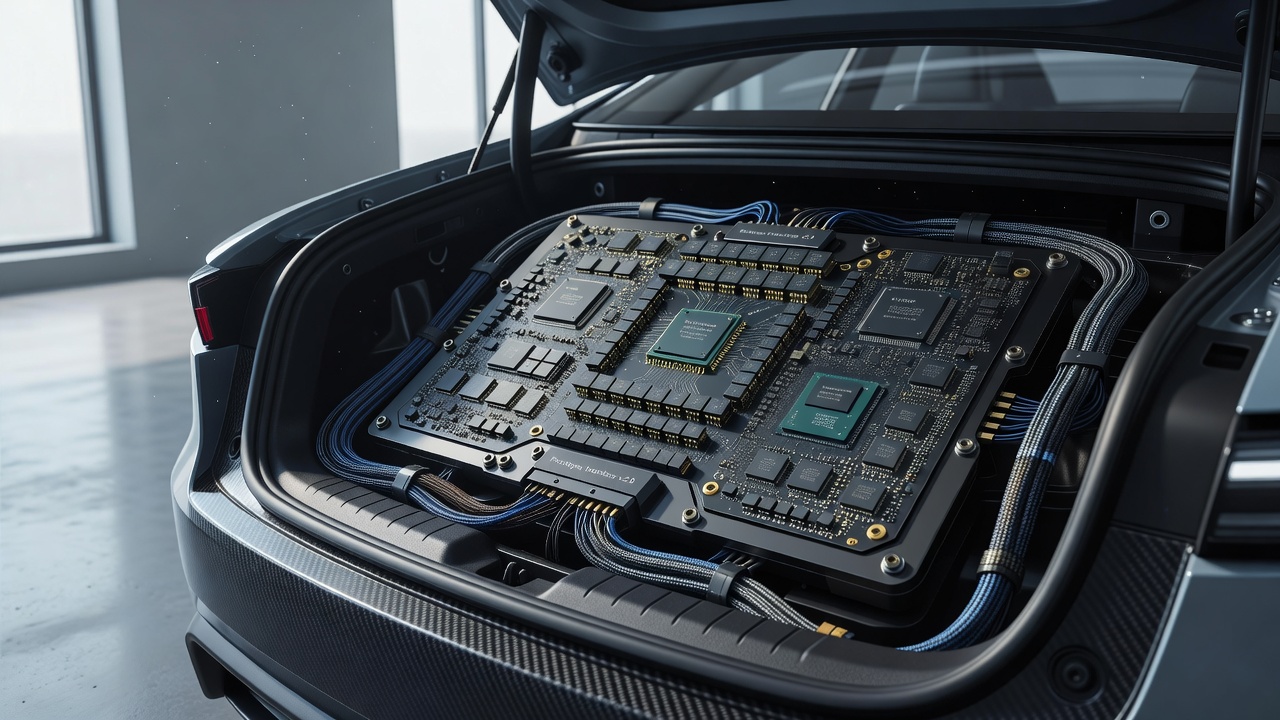
The logic was brutal in its simplicity. A car that drives itself cannot wait for a cloud round-trip. It needs inference on the metal, at latency measured in microseconds, with a power budget that doesn't melt the trunk. Apple's silicon team took that constraint and built a dedicated AI accelerator — first for a vehicle that never launched, then for the iPhone X and A11 Bionic. FaceID arrived. Animoji followed. Augmented reality demos worked. The Neural Engine proved its worth on a platform that mattered.
Now the M-series carries that DNA to the desktop. Apple's unified memory architecture — CPU, GPU, Neural Engine sharing a single pool — exists because the car program forced engineers to solve memory bandwidth at scale. The privacy marketing writes itself: your data stays on device because the hardware can actually run the models. Convenient that the privacy story aligns perfectly with the silicon roadmap.
But let's be clear about what Apple has and hasn't achieved. The hardware lead is real. The software lag is equally real. Siri remains a punchline. Core ML tools frustrate developers. The generative AI wave broke over Cupertino while Apple polished silicon. The Neural Engine is a magnificent engine waiting for a transmission that Apple's software org has not built.
Mark Gurman's reporting reveals the next move: Apple is cancelling M6 Pro, Max, and Ultra. They're jumping straight to M7, targeting first-half 2027, with "significant Neural Engine upgrades." That skip is not routine. It signals urgency. The M6 family would have been iterative. M7 is a swing for the fences.
The 1.5TB RAM ceiling on M7 Ultra is the tell. No consumer workload needs that. No Mac Pro buyer configures that. That number exists for one reason: server racks. Apple is building the silicon to run its own inference cloud — or to sell that silicon to others who want Apple's performance-per-watt advantage in their data centers. The car program's ghost is haunting the server room.
This strategy inverts the industry playbook. Nvidia sells shovels to gold miners. Apple wants to mine its own gold and keep the map secret. The Neural Engine gives them that option. If Apple Intelligence ever becomes competitive, the inference cost structure collapses to near zero because Apple owns the stack from transistor to tokenizer. That is the car program's true legacy: not autonomy, but optionality.
The risk is obvious. Hardware leads evaporate. Google's TPUs, Amazon's Trainium, Microsoft's Maia — custom silicon is commoditizing fast. Apple's advantage holds only if the Neural Engine keeps widening its lead over merchant accelerators. That demands relentless architectural bets, not incremental shrinks. Skipping M6 Ultra suggests Apple knows this.
Meanwhile the software gap yawns. A 1.5TB RAM server chip means nothing if the models running on it hallucinate, lag, or refuse to integrate with developers' workflows. Apple's culture treats software as a feature checklist. AI demands a platform mindset. The car program failed partly because Apple couldn't turn sensors into judgment. The same cultural injury hampers the LLM push.
Yet the silicon is undeniable. Hold an M3 Max. Run a 70B parameter model locally. Watch the unified memory feed the Neural Engine without paging. That experience — silent, instant, private — exists because a thousand engineers spent years solving for a steering wheel that never turned. Failure, properly mined, becomes foundation.
The M7 timeline is aggressive. First-half 2027 leaves zero margin for tape-out surprises. Apple's silicon team has earned trust — they've hit every major transition from A-series to M-series on schedule. But they've never attempted a server-class die with 1.5TB memory controller validation. That's new physics.
Watch the developer conference signals. If WWDC 2025 ships Neural Engine kernels that make PyTorch feel native, Apple is serious about the software half. If they ship another convert-your-model-to-CoreML workflow, they're still hoping hardware alone wins. It won't.
The car program died. The chips it forced into existence now define Apple's AI ceiling. That ceiling just moved to 1.5TB and a server rack. The question isn't whether the silicon will arrive. It's whether Apple can finally write software worthy of it.