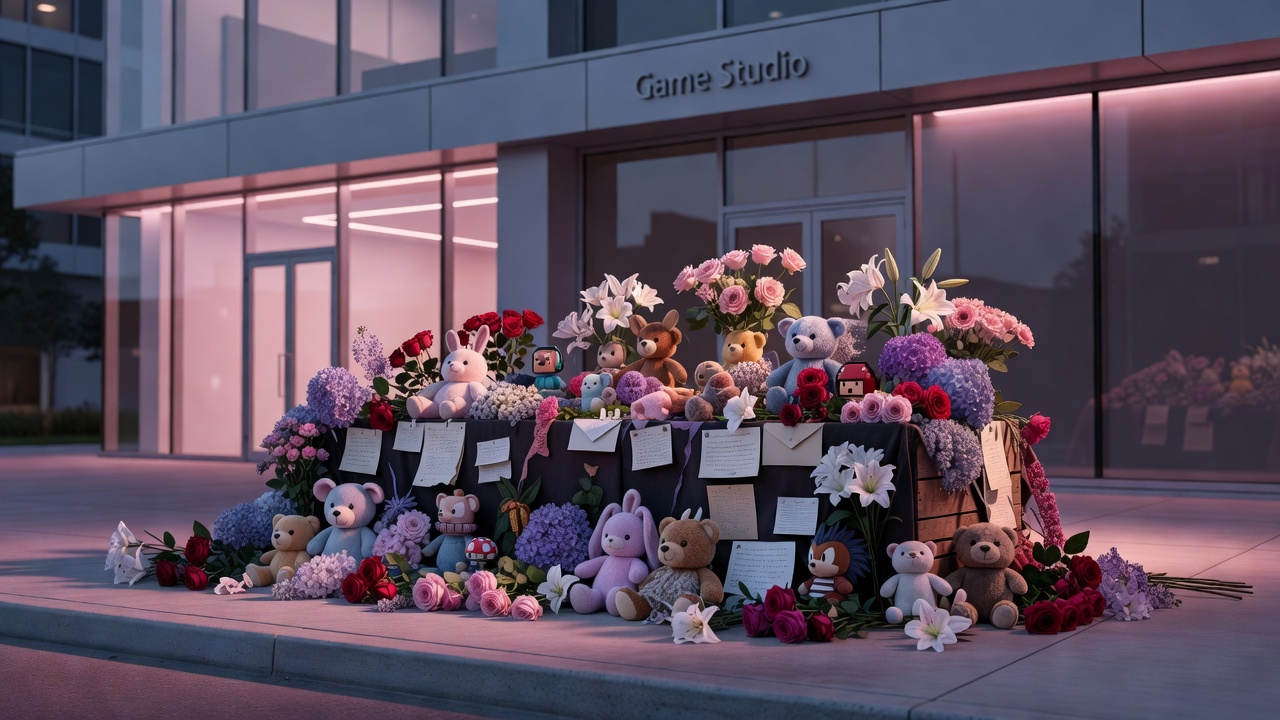
The flowers are real. The tears are real. The cardiovascular auxiliary police officers standing by Infold's Shanghai headquarters are very, very real. And the object of all this grief? A wolf-man who never existed.
If you're not terminally online in the otome sphere, the sight of hundreds of young Chinese women holding a wake for a JPEG — a "wolfy love interest" named Valko who was scheduled to debut in Love and Deepspace on July 9 — looks like mass hysteria. It's not. It's a contract dispute played out in the language of fandom, and Infold just breached the most expensive clause in the live-service playbook: don't sell the roadmap, then burn the map.
The most expensive "we're not ready" in gacha history
Let's be precise about what happened. Infold didn't delay Valko. They didn't rework him. They deleted him — six days before launch, after months of marketing, after players had spent real currency pulling for his supporting cast, after the character had been fully voiced, animated, and integrated into the game's narrative framework. The company's statement is a masterclass in corporate nothing-speak: "After reflecting on recent events, we recognize that we moved forward with the introduction of Valko before we were truly ready."
What events? Whose reflection? "Truly ready" by whose metric — creative, technical, or political? The silence is deafening, and in that vacuum, the worst theories take root. Censorship pressure? Internal factional warfare? A licensing snafu with the voice actor? The ambiguity is the point. It lets Infold avoid accountability while players fill the gaps with their darkest suspicions.
This isn't entitlement. It's consumer protection.
The petition — 78,000 verified signatures and climbing — isn't demanding free content. It's demanding delivered content. "Many players spent money believing the game would continue expanding its romantic routes," reads one comment. "Canceling Valko feels like a bait-and-switch and a material change to the game after monetization." That's not fan entitlement. That's a description of fraud in jurisdictions with functioning consumer laws.
Love and Deepspace isn't a premium title you buy once. It's a live-service gacha where the business model relies on anticipation as a currency. Every banner, every roadmap, every "coming soon" trailer is a promissory note. Players don't just pay for what's in the game today; they pay for the future the developer sells them. When Infold erased Valko, they didn't just cut content. They defaulted on the debt that keeps the entire economy running.
The funeral is for trust, not a wolf
That's why the memorial at the Diezhi building matters. The chocolates shared between strangers, the hand-holding, the bouquets rejected by security — these aren't performative grief for a fictional husband. They're a ritualized demand for respect. "When I first arrived and saw that wall, I couldn't help but cry," one attendee wrote. "A girl shared her chocolate with me, another girl was herself choked up as she comforted me and held my hand."
That's community. That's the social infrastructure Infold monetizes every single day. The parasocial bonds between players and characters are the product, but the bonds between players are the retention mechanic. Infold just torched both.
A pattern, not an anomaly
This isn't the first time a gacha developer has memory-holed a promised character. Honkai: Star Rail players still remember the "Sparkle was supposed to be playable in 1.0" rumors. Genshin fans have cataloged years of cut content. But those were whispers, datamines, things never officially promised. Valko was official. He had a release date. He had a kit. He had a trailer. He was real in every way that matters to the contract between developer and player.
The difference is Love and Deepspace's demographic. Otome players — overwhelmingly women, overwhelmingly ignored by mainstream gaming discourse — have built a consumption model where emotional labor is the gameplay. The romance is the mechanics. You don't "main" a character in LADS; you date him. The investment is intimate by design. Infold knows this. They built the machine that converts intimacy into revenue. Then they broke the machine because... they "weren't ready"?
The silence is the strategy
As of this writing, Infold has not addressed the protest. They haven't clarified the "recent events." They haven't explained why "not ready" means "erased from existence" rather than "delayed to Q4." They're betting on the industry's oldest truism: gamers have short memories, the next banner drops in three weeks, and revenue recovers.
They might be right. But they've also handed the community a martyr. Valko is now a symbol — not of a wolf-man, but of every promise a live-service game has ever broken. The funeral isn't the end of the story. It's the founding myth of a grievance that will outlast this banner, this quarter, maybe this game.
Seventy-eight thousand signatures don't lie. Neither do the flowers piling up at a corporate gate the company wishes it could lock. Infold didn't just cancel a character. They cancelled the benefit of the doubt. In this genre, that's the only currency that matters.