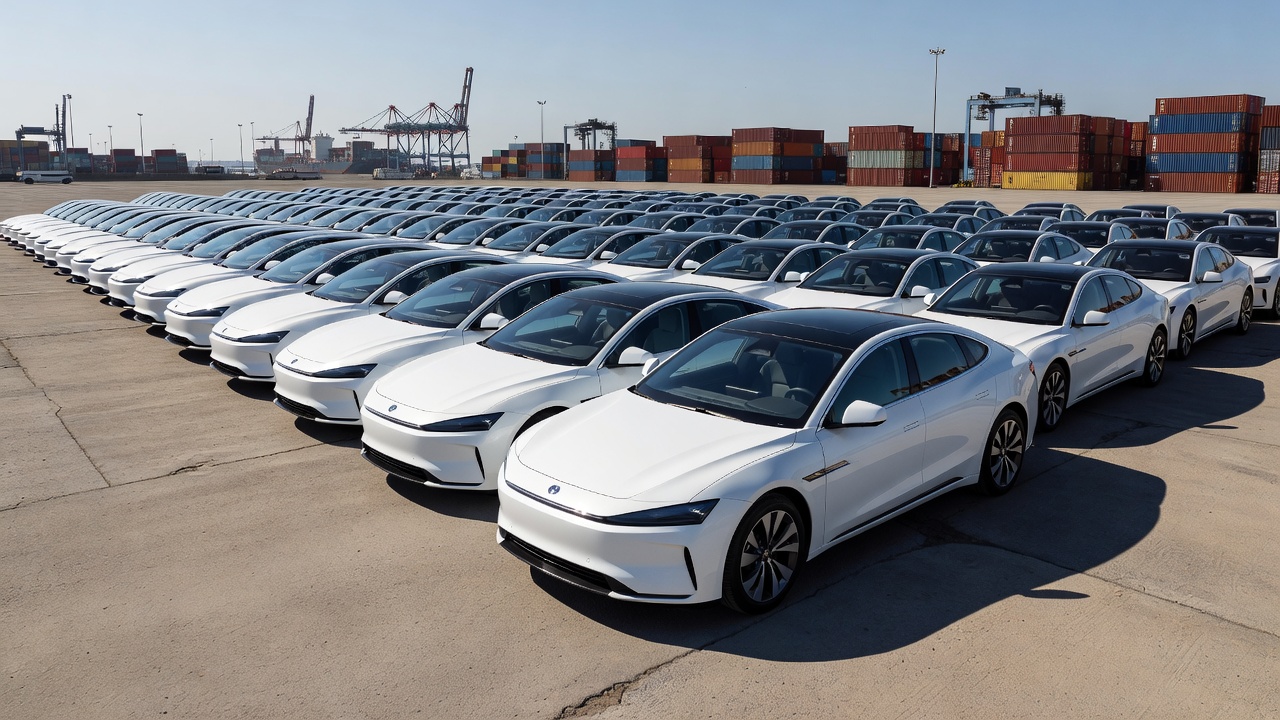
Tesla saw a massive sales jump in the second quarter
Let’s not kid ourselves: Tesla’s Q2 delivery beat is a relief rally, not a renaissance. The headline — 480,000 vehicles shipped, a 120,000-unit jump from Q1 — looks spectacular on a Bloomberg terminal. But peel back the confetti and you find a company still running downhill, just a little slower.
The numbers hide a structural rot
Tesla built 451,758 cars in Q2. It delivered 467,762. That means it drew down inventory by roughly 16,000 units — a healthy sign, until you remember that inventory had ballooned to historic highs in Q1 because nobody wanted to buy at January prices. The “massive jump” is largely a function of price cuts, cheaper trims, and aggressive financing. The Model 3 and Model Y — 442,936 of production — are the only volume drivers. Everything else is noise: 12,364 “other models” includes the Cybertruck, the dying Model S and X lines, and presumably a few Semis lost in the desert.
Wall Street expected 440,000 deliveries. Tesla cleared 467,000. The bar was on the floor. Beating lowered expectations is not the same as growth. Year-over-year, deliveries are still down. The two-year declining sales trend the source mentions? That’s the real story. Q2 2024 was better than Q1 2024. But Q2 2024 was worse than Q2 2023. And Q2 2023 was worse than Q2 2022. That’s not a blip. That’s a trajectory.
Cheaper cars, cheaper brand
The source credits “cheaper versions of the Model 3, Model Y, and Cybertruck” for bucking the trend. Let’s translate: Tesla is cutting prices to maintain volume, sacrificing the premium positioning that once justified its valuation. The refreshed Model 3 “Highland” and the rear-wheel-drive Model Y launched in the U.S. at lower price points. The Cybertruck’s long-promised $60,000 variant remains vaporware; what’s delivering now is the $100,000+ Foundation Series — a halo product for influencers, not a volume driver.
This is the classic automaker trap: chase volume with discounts, watch margins erode, lose the pricing power that made you a tech stock. Tesla’s automotive gross margin (ex-credits) has fallen from 27% in Q1 2023 to the high teens. Every “beat” financed by price cuts brings the company closer to Toyota territory — without Toyota’s hybrid profitability or dealer network.
Geographic expansion is a euphemism for “China is slowing”
The source nods to “geographic expansion.” Code for: Tesla is shipping more cars to Europe, the Middle East, and Southeast Asia to offset weakening demand in the U.S. and China. In China, BYD and Xiaomi are eating Tesla’s lunch with better software, faster iteration, and prices Tesla can’t match without losing money. The Model Y was China’s best-selling car in 2023. In 2024, it’s fighting for top five. Tesla’s response? Export Shanghai-built cars to Canada, Australia, Thailand — anywhere the tariff math works.
That’s not expansion. That’s diversion. And it depends on a fragile geopolitical truce. If the U.S. slaps 100% tariffs on Chinese EVs (as the Biden administration has signaled), and the EU follows with provisional duties, Tesla’s Shanghai hub becomes a liability, not an asset. Elon Musk’s cozy relationship with Beijing buys goodwill, not immunity.
The Musk distraction tax
None of this happens in a vacuum. The CEO is running X into the ground, pickling his brain in ketamine (per the Wall Street Journal), and threatening to move Tesla’s AI brain to xAI unless he gets 25% voting control. The board — captured, conflicted, asleep — lets him. Investors price in a “Musk premium” for vision. They’re now paying a “Musk discount” for chaos.
Meanwhile, FSD (Full Self-Driving) remains Level 2. Robotaxi day keeps sliding. Optimus is a teleoperated parlor trick. The energy storage business — Megapack, Powerwall — is the only division growing profitably and predictably. It’s also the least valued by a market that still thinks Tesla is an AI company.
What Q2 actually proves
Tesla can still move metal when it cuts prices hard enough. That’s it. The 480,000 figure is a testament to operational discipline in Fremont, Shanghai, Austin, and Berlin — factories that run better than any legacy OEM’s. But operational excellence without strategic clarity is just efficient decline.
The bull case: Q2 inflects. Cheaper models unlock a new demographic. FSD v12.5 actually works. Tariffs protect the U.S. moat. Energy storage becomes a $50B run-rate business. The bear case: the two-year slide continues. Margins compress to 12%. Chinese competition goes global. Musk gets bored and sells stock to fund Mars.
History suggests the truth lives in the muddy middle. Tesla isn’t dying. But it’s no longer the inevitable winner of the EV transition. It’s just another car company — cyclical, capital-intensive, and increasingly commoditized. The “massive sales jump” is a sugar high. The crash comes when the discounts stop working.
Watch Q3. Watch inventory. Watch margins. And for the love of Newton, stop grading on a curve.