South Korea's hot new sensation is 3S+1F – a quadrillion-Won AI plan, not a band
Seoul has a knack for export hits. First it was K-pop, then K-drama, then K-beauty. Now the government wants you to hum along to 3S+1F — a 1,000 trillion won (roughly $730 billion) bet that South Korea can muscle its way into the AI big leagues. The name sounds like a boy-band lineup: Semiconductors, Supercomputing, Software, plus one F for Fusion. But the price tag is no novelty act. It's a sovereign wealth fund's worth of capital aimed squarely at the choke points the US and China have spent the last decade locking down.
Let's be clear: this isn't industrial policy. It's existential policy. South Korea's economy runs on two engines — memory chips and shipbuilding — and both are sputtering. Samsung and SK Hynix still own the DRAM market, but the high-bandwidth memory that feeds Nvidia's GPUs is a shrinking slice of a pie that Jensen Huang intends to bake himself. The shipyards are busy, but the order book is LNG carriers, not the autonomous surface vessels the next conflict will demand. 3S+1F is the state admitting the old model is dead and writing a blank check for the next one.
The semiconductor at the center of the world
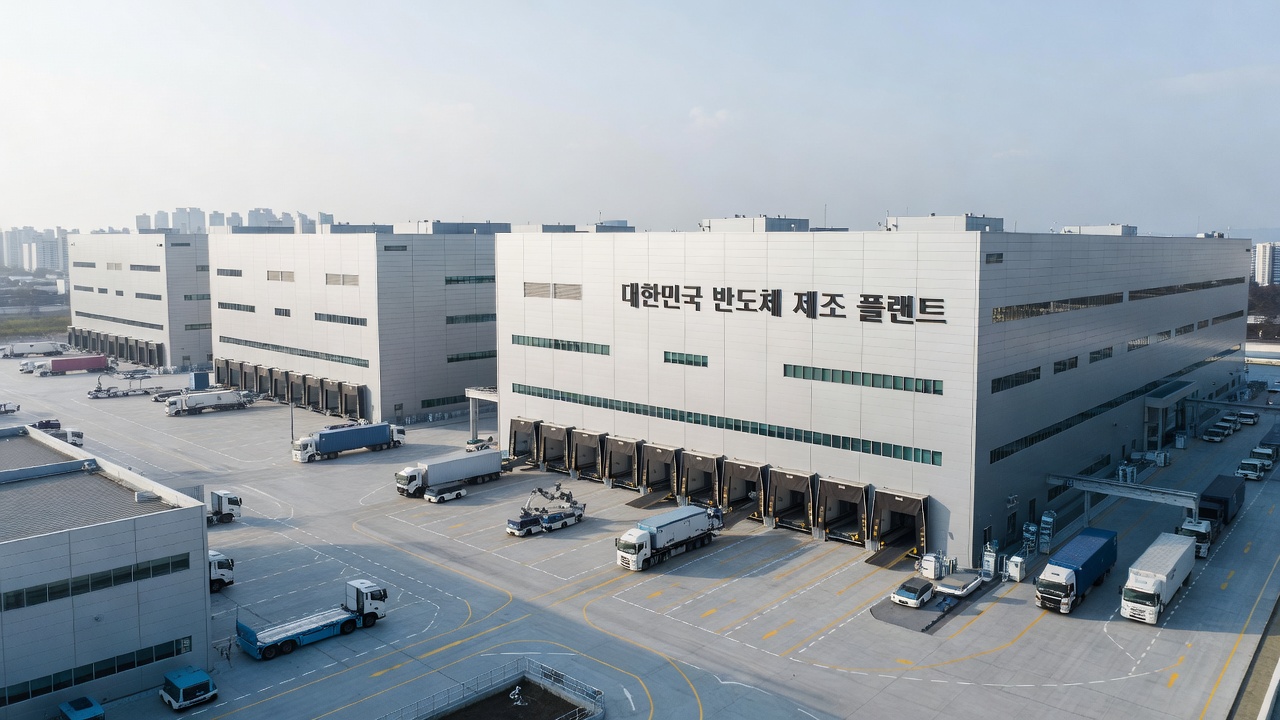
The first S is the one that matters. Semiconductors aren't just an industry in Korea; they're the national balance sheet. The plan promises 340 trillion won for chip R&D and fab construction by 2030, targeting 2nm logic and next-gen HBM4. That's the same node TSMC and Intel are bleeding billions to reach, and Samsung's foundry business has yet to prove yield parity. But Korea has something neither does: a government willing to treat capacity as strategic infrastructure, not quarterly ROI. When the US CHIPS Act dribbles out $39 billion in grants with strings attached, Seoul can move 10x that in a single budget cycle.
The risk is Samsung itself. The chaebol's foundry division is the plan's linchpin, yet it's also the company that just replaced its mobile chief after missing the AI phone cycle and watches its foundry market share hover at 11% to TSMC's 62%. Pouring public trillions into a family-controlled conglomerate that still crosses its fingers on EUV yield is the kind of moral hazard that makes Western economists clutch their pearls. In Seoul, they call it Tuesday.
Supercomputing: buying time on someone else's architecture
The second S — Supercomputing — reveals the dependency Korean planners hate to admit. The target: exascale by 2027, zettascale by 2030. The reality: every credible path runs through Nvidia GPUs or, increasingly, US-designed custom silicon. Korea's homegrown AI accelerator, the NPU from Rebellions and Sapeon, is a creditable effort, but it's fighting CUDA's 15-year moat. The government knows this. That's why the plan quietly budgets for "strategic procurement" — code for buying H100s and B200s by the container load while domestic silicon matures.
It's a pragmatic surrender. Japan's Fugaku proved you can build world-class iron on Arm; Korea is betting it can do the same on RISC-V. But until the software stack exists, the supercomputing budget is a very expensive Nvidia subscription.
Software: the graveyard of Korean ambition
The third S is where the plan gets uncomfortable. Korea has never cracked software at scale. Naver and Kakao dominate domestic search and chat, but their global footprint rounds to zero. The government's answer is a 150 trillion won "AI innovation ecosystem" — subsidies, talent visas, and a national data platform that promises to unlock public-sector datasets for training. It's the same playbook that failed to birth a Korean Microsoft, a Korean Google, a Korean anything in software.
The difference this time is the fusion variable. The "1F" — Fusion — means forcing AI into shipbuilding, biopharma, nuclear, and defense. Hanwha's autonomous turrets, Hyundai's robotaxis, Samsung Biologics' drug discovery — these aren't pilots; they're revenue lines. Vertical integration is how you monetize models without needing a consumer app store. It's also how you justify the spend to a parliament that still thinks AI is a chatbot.
The governance vacuum nobody mentions
Buried in the 3S+1F white paper is a single paragraph on "AI safety and ethics." It references the UN's interim report on global governance — the one warning that capabilities are racing ahead of rules — and promises a domestic framework by 2025. That's it. No compute thresholds, no model registration, no liability regime. While the EU finalizes its AI Act and the US issues executive orders on frontier models, Korea is treating governance as a compliance checkbox.
This isn't negligence. It's calculation. The same government that greenlit 3S+1F watched the US restrict HBM exports to China and realized regulatory alignment with Washington is the only export license that matters. Korea will adopt whatever rules the US and EU settle on, then certify compliance faster than anyone else. It's the fast-follower strategy applied to law.
A quadrillion reasons to watch
3S+1F will be judged on three metrics: foundry yield at 2nm, domestic NPU adoption in hyperscalers, and whether the fusion verticals generate export revenue before the won hits 1,400 to the dollar. The money is real. The political will is real. The structural advantages — unified government, chaebol scale, engineering density — are real.
What's not real is the idea that capital alone closes the gap. TSMC's moat is process knowledge accumulated over three decades. Nvidia's moat is a software ecosystem that turns hardware into a platform. Korea has neither, and 3S+1F treats both as procurement problems. They're not. They're culture problems.
But here's the uncomfortable truth for Silicon Valley: Korea doesn't need to beat you at your game. It just needs to own the substrate your game runs on. Every H100 needs HBM. Every data center needs power semiconductors. Every autonomous system needs sensor fusion. 3S+1F isn't trying to build the next ChatGPT. It's trying to make sure the next ChatGPT can't exist without Korean silicon, Korean substrates, Korean power ICs.
That's not a band. That's a stranglehold. And at a quadrillion won, they're buying it in bulk.