Key Takeaways
- Enigma raised a $70M seed round — an absurd sum for a sub-one-year-old lab — to solve the interface problem before the intelligence problem
- The founders are cybersecurity prodigies, not roboticists; their backers call that a feature, not a bug
- A public experiment with 100-plus robots in hangars across two continents will let anyone online direct machines to sword-fight, paint, and run chemistry demos
- The bet: if you nail effortless control, the model architecture may not matter as much as the industry assumes
Seventy million dollars buys a lot of GPUs. It buys a lot of PhDs. It does not, historically, buy a seed round for a robotics company that has not yet shipped a product, named a customer, or published a benchmark. Enigma just did it anyway.
The money comes from Index Ventures and Ribbit Capital, with Conviction Partners' Sarah Guo along for the ride. That is a serious cap table for a team whose combined robotics experience rounds to zero. Jonathan Jacobi and Gal Niv met hacking in their teens, then spent years in Unit 8200, Israel's elite cyber unit. Jacobi became Microsoft's youngest-ever hire. Niv built detection systems at Wiz. They know how to break things and how to secure things. They do not know how to make a robot fold a shirt.
That is exactly why their investors wrote the check. Shardul Shah at Index Ventures puts it plainly: insiders start from teleoperation and dexterity. Enigma starts from "what's the ultimate experience?" The distinction matters. The current wave of embodied AI — Figure, Physical Intelligence, Skild, the rest — obsesses over model generality. Can the same weights that pick up a cup also tie a shoelace? Enigma thinks that question is premature. The real bottleneck, they argue, is not the brain. It is the joystick.
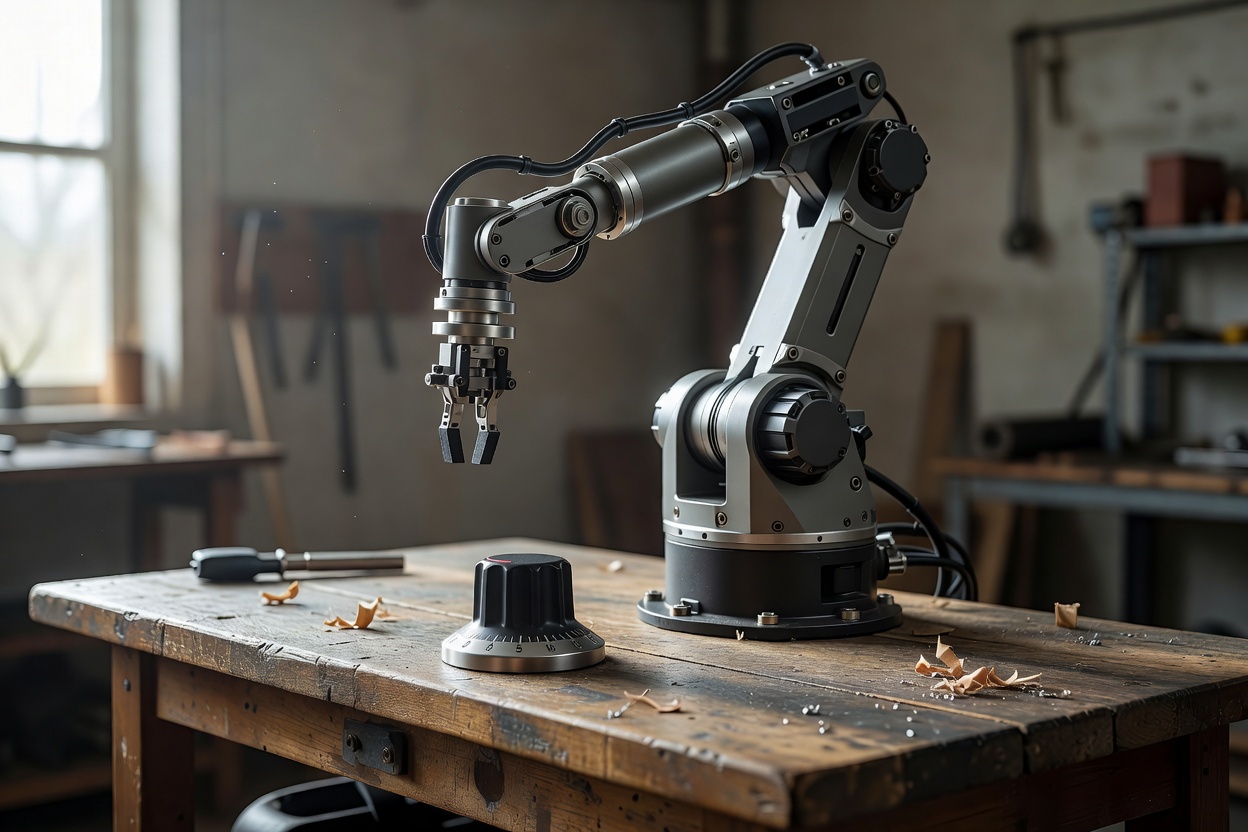
So they built 100-plus robots. Custom arms, custom hands, custom sensors. They parked them in hangars in Israel and California. Starting Monday, anyone with a browser can log in and tell them to duel with swords, mix chemicals, paint pictures. The tasks are theatrical. The data is the point. Every human 입력 — every hesitation, every correction, every "no, left a bit" — becomes training signal for an interface layer that Enigma hopes will eventually make robot control as trivial as a volume slider.
The claim is audacious. "If you had to do your dishes and spent 15 minutes explaining to a robot where to put everything, everyone reaches the point of 'forget it, I'll do it myself,'" Jacobi told TechCrunch. He wants that threshold gone. He wants a grandmother to direct a humanoid as easily as she adjusts her TV.
Skepticism is warranted. The history of human-robot interaction is a graveyard of intuitive interfaces that weren't. Voice, gesture, teach pendants, VR teleop — each promised to be the last interface you'd ever need. Each failed when the edge cases piled up. Enigma's hangars are controlled environments. The internet is not. Latency, packet loss, ambiguous intent, malicious users — the public experiment will stress-test the interface in ways a lab never could. That is either brilliant or reckless. Probably both.
The team composition sharpens the bet. Jacobi and Niv recruited "their smartest friends" — math Olympiad winners, AI lab alumni, PhD dropouts. No roboticists. No one who has spent a decade fighting friction coefficients and cable routing. That absence could be fatal when the arms start failing in ways no simulation predicted. Or it could be why they see a path everyone else missed. Outsiders often do.
The $70M gives them runway to find out. Most seed rounds in this space land between $5M and $20M. At $70M, Enigma can run the hangars, pay the compute, and hire the talent without raising again for years. It also sets a valuation expectation that will make a Series A brutally difficult if the public experiment yields mostly noise. The investors know this. They priced the optionality, not the traction.
What happens next is not a product launch. It is a data harvest. Millions of humans, thousands of hours, a corpus of intent-expression pairs that no one else owns. If Enigma can distill that into a control layer that generalizes — if "move left" means the same thing whether the robot holds a brush, a sword, or a flask — then the model underneath becomes swappable. Commodity. The interface becomes the moat.
That is the real story. Not the robots. Not the seed size. The wager that the hard problem in robotics is not intelligence but translation — and that the company which solves translation first wins, regardless of whose model sits on top. Jacobi and Niv are betting their reputation, their investors' capital, and a hangar full of custom steel on that thesis. The internet gets to watch them prove or disprove it starting Monday.