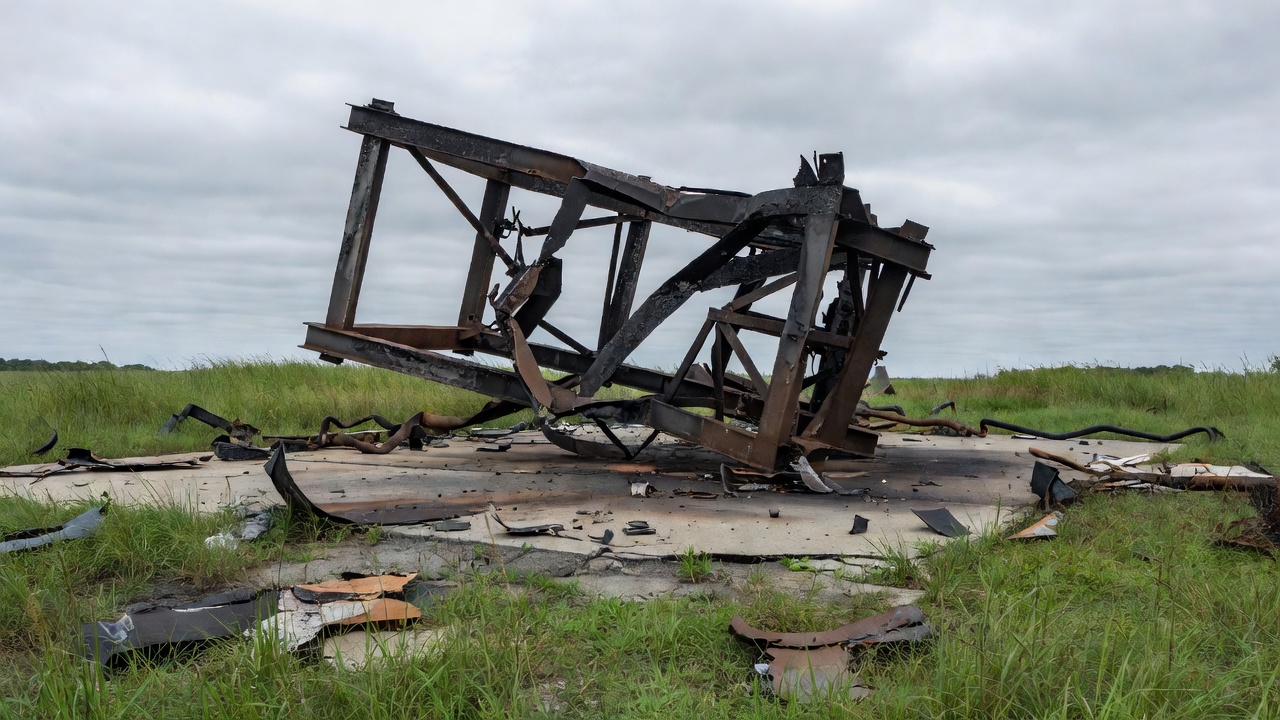
The rocket motor didn't just fail. It exploded. And in that violent, expensive instant at Anduril's McHenry, Mississippi test site, the fantasy of Silicon Valley speed colliding with defense industrial reality went up in smoke — literally.
Let's be clear about what happened last Friday. This wasn't a "rapid iteration" or a "learning event" in the sanitized language of startup culture. A test stand — the critical infrastructure for validating propulsion systems — was destroyed. The timeline for mass production, already a year past its July 2025 target, just slipped further into the indefinite future. And Anduril's leadership responded not with transparency, but with a social media post dropped only after WIRED came knocking.
That sequence tells you everything you need to know about where Anduril actually sits on the maturity curve.
The Monopoly Problem Is Real — But So Is the Physics
The Pentagon's desperation to break the Northrop Grumman-Aerojet Rocketdyne-L3Harris stranglehold on solid rocket motors is legitimate. Decades of consolidation have left the DoD with a brittle supply chain, eye-watering prices, and zero leverage. The 2023 National Defense Industrial Strategy explicitly calls for new entrants. Anduril, valued at $61 billion and flush with political capital, looked like the answer.
But solid rocket motors aren't drones. They aren't sensor towers. They are controlled explosions contained in a tube, subject to material science, chemistry, and thermodynamics that don't care about your sprint velocity or your Series F valuation. The propellant grain geometry, the case bonding, the nozzle erosion — these are problems measured in decades of institutional knowledge, not quarters of venture funding.
A former Pentagon official who helped award Anduril's grant told WIRED he anticipated "years of delays despite the company's promises." That wasn't pessimism. That was pattern recognition.
Move Fast and Break Expensive Things
Anduril's defenders — founder Palmer Luckey, chairman Trae Stephens — frame criticism as "whining about inane stuff" and celebrate "scaling faster than anyone in this industry." This is the standard Silicon Valley playbook: dismiss safety concerns as bureaucracy, redefine recklessness as velocity, and treat hardware destruction as the cost of disruption.
It works great for software. It works terribly for energetics.
When a drone prototype crashes, you write a postmortem and print another airframe. When a rocket motor test stand explodes, you've just vaporized months of schedule, millions in specialized tooling, and — most critically — the confidence of the program managers who have to sign off on putting your motors on actual missiles. The "disciplined iteration" Grimm cites in his post is a contradiction in terms. Discipline in this business means not blowing up the test stand.
The Mississippi Reality
The March reporting on McHenry — an employee burned by an igniter, capital equipment that "failed to perform as intended" — wasn't "inane stuff." It was the leading indicator of a facility operating without the safety culture and procedural rigor that the legacy primes built over generations, often written in blood. You don't "iterate" your way out of a safety culture deficit. You build it, slowly, expensively, boringly.
Anduril's Mississippi operation is trying to compress 30 years of institutional learning into a venture timeline. The explosion is the bill coming due.
What This Means for the Industrial Base
The Pentagon's strategy of funding startups to challenge primes is sound in theory. In practice, it's creating a two-tier problem: the primes are too slow and expensive, but the challengers aren't ready. The Raytheon/RTX and Lockheed Martin production lines keep humming because they have to — there's no one else qualified to deliver.
Anduril will rebuild the test stand. They'll probably eventually produce motors. But the "July 2025" deadline wasn't missed by a quarter — it was missed by a year, and the gap is widening. The DoD should take this as a data point: disruption in energetics isn't a software problem. It's a capital-intensive, regulation-heavy, physics-constrained manufacturing problem that takes the time it takes.
The next time a founder tells you they're going to "move fast and break things" in missile propulsion, ask them to show you the test stand. Then ask them what happens when it's gone.
Physics doesn't negotiate. And it doesn't care about your valuation.