Key Takeaways
- Nolan frames AI as a transparent Trojan horse the public already sees through.
- Young audiences reject generative output with the blunt label "AI slop."
- The Directors Guild secured contractual AI protections while Hollywood unions struck over the same threat.
- Nolan's techno-skepticism defends film as a superior capture of human vision.
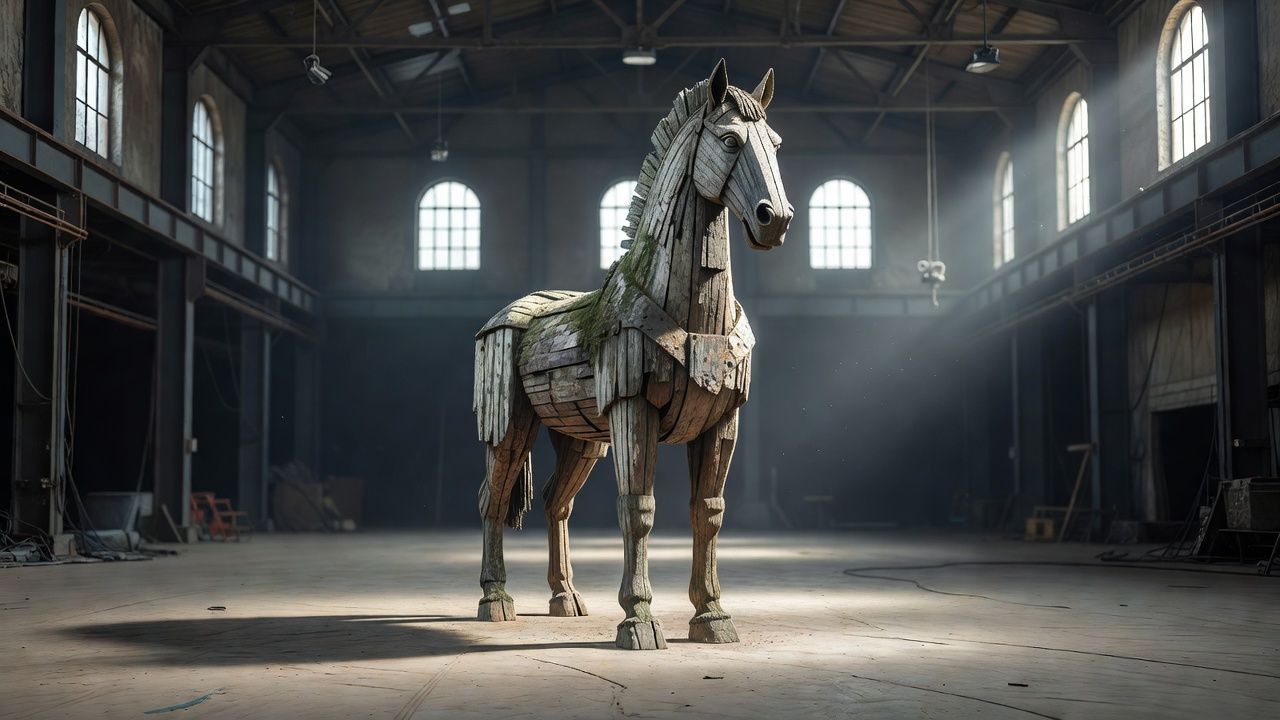
Christopher Nolan does not flinch when he calls AI a Trojan horse made of glass. The metaphor lands because the Greeks inside are visible to everyone, especially the generation that will inherit the consequences. When Hugo Travers pressed the comparison, Nolan laughed, then doubled down: the horse is transparent, the threat is obvious, and the public's suspicion is not paranoia but pattern recognition.
That suspicion has a name now. "AI slop" erupted from teenagers scrolling TikTok and YouTube, a dismissal so instantaneous it bypasses critique entirely. Nolan finds this encouraging. He should. The industry that pays him has spent two years fighting strikes over exactly this technology, and the Directors Guild of America — where Nolan serves as president — just negotiated generative AI guardrails into its contract. The labor movement understood the horse before the studio executives did.
Nolan's resistance to smartphones and his insistence on Imax film for "The Odyssey" make him an easy target for the "Luddite" label. The New York Times asked him directly. His answer — "techno-skeptic" — reframes the posture. He does not reject tools; he rejects the sales pitch that declares old tools obsolete the moment new ones arrive. Film survived because directors like him refused to throw the baby out with the bathwater. Digital imaging still cannot match the way the eye sees the world, he argues, and he has the receipts: a box-office conqueror shot entirely on celluloid.
The motive question cuts deeper. Nolan insists we scrutinize who hands us the horse. In Hollywood, the givers are studios chasing margin expansion, tech giants harvesting training data, and shareholders demanding quarterly growth. Their interests do not align with writers, actors, or directors — let alone audiences. The 2023 strikes proved that alignment requires leverage, not trust. The DGA contract provisions are a beachhead, not a victory.
Young people's rejection of AI slop is not aesthetic snobbery. It is a survival instinct. They have watched platforms degrade search, social feeds, and now creative output into engagement-optimized filler. They recognize the pattern because they live inside it. When Nolan calls their skepticism healthy, he validates a generational intelligence that the industry spends millions trying to manufacture artificially.
The transparency of the horse changes the game. Previous technological disruptions — sound, color, CGI — arrived as opaque gifts. The industry could negotiate terms after adoption. AI arrives with its code exposed, its training data scrutinized, its labor displacement quantified in real time. The public sees the Greeks loading into the belly before the gates open. That visibility forces accountability that studio lobbyists cannot spin away.
Elon Musk's rage-posting about the film's casting reveals the parallel culture war. The same figures hyping AI as inevitable progress attack artistic choices that reflect actual human diversity. Their vision of the future is algorithmic homogeneity wrapped in disruption rhetoric. Nolan's film — shot on film, cast broadly, skeptical of the horse — stands as a counter-model: technology serving craft, not replacing it.
The director's career embodies the tension. He pushes Imax cameras to new limits while refusing a pocket computer. He embraces practical effects that require engineering breakthroughs while rejecting digital intermediates that flatten texture. This is not contradiction. It is discrimination. He adopts tools that expand the palette and discards tools that shrink the decisions.
Hollywood's next contract cycle will test whether the DGA protections hold. Studios will probe for loopholes. Tech companies will offer "assistive" plugins that quietly become generative. The horse will be repainted, relabeled, repositioned. But the glass remains glass. The Greeks remain visible. And the generation that coined "AI slop" is aging into hiring power.
Nolan's intervention matters because he occupies the rare seat where artistic authority meets industrial leverage. He does not need to specify the threat in technical detail. His job is to keep the gate closed until the terms are written by the people who make the work, not the people who monetize the pipeline. The horse is transparent. The Greeks are inside. The gate stays shut.